
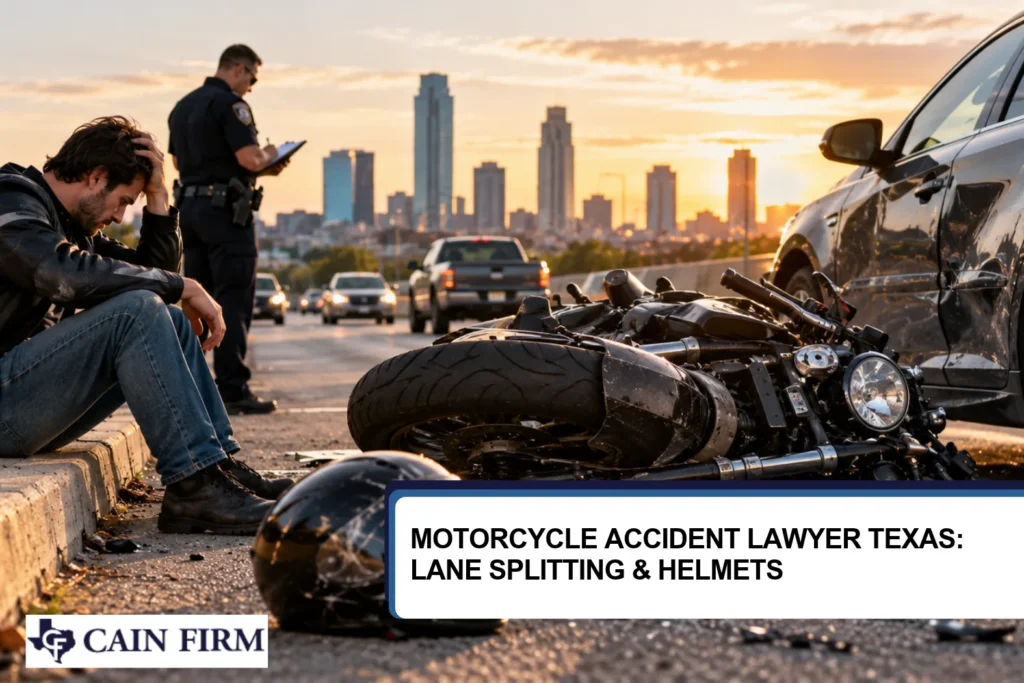
A driver starts a left turn and says they never saw your motorcycle. An insurer then asks whether you were riding between lanes, how fast you were going, whether you had a helmet, and whether your motorcycle license was valid. Suddenly, a crash that appeared straightforward becomes an argument about Texas motorcycle law.
That is where a motorcycle accident lawyer can help separate actual legal rules from assumptions about riders.
Texas law changed in 2023 to expressly prohibit motorcycles from operating between lanes of traffic moving in the same direction. Texas also has a partial helmet law rather than a universal helmet requirement. On top of those motorcycle-specific rules, Texas uses proportionate responsibility, meaning a rider’s own conduct can affect an injury claim when it contributed to the crash or damages.
The stakes are substantial. TxDOT reports that 557 motorcyclists died and 2,468 suffered serious injuries on Texas roads in 2025.
This blog explains the current rules, how insurers may use them, and what injured riders should preserve after a crash.
The Texas Motorcycle Laws That Matter Before and After a Crash
Texas riders have the same basic duty to follow traffic laws as other motorists, but several rules apply specifically to motorcycles.
Understanding those rules matters because an insurance company may examine every possible traffic violation after a crash.
Motorcycles are entitled to a full lane
Texas Transportation Code Section 545.0605 states that a motorcycle operator is entitled to full use of a lane. Other motorists generally may not drive in a way that deprives a motorcycle of that full lane. Texas also permits two motorcycles to ride abreast in the same lane, although more than two abreast is prohibited.
This rule can become important after sideswipe and merging crashes. A driver cannot simply argue that a motorcycle should have moved to the edge of its own lane to make room.
Texas requires motorcycle authorization
A Class M license authorizes a person to operate a motorcycle. Texas DPS states that applicants for an original motorcycle license or motorcycle authorization generally must complete an approved motorcycle safety course.
License status may become part of an insurance investigation, but it should not be confused with the separate question of who actually caused the collision.
Is lane splitting legal in Texas?
No. Texas law prohibits motorcyclists from riding between lanes of traffic moving in the same direction.
Texas Transportation Code Section 545.0605 expressly prohibits a motorcycle operator from operating between lanes of traffic moving in the same direction. It also prohibits passing another motor vehicle while remaining in the same lane as that vehicle. The statute took effect on September 1, 2023.
Lane splitting versus riding two abreast
These two activities are not the same.
Texas permits two motorcycles to ride side by side in a single lane. It does not permit a rider to travel between rows of cars moving in the same direction.
A police officer performing official duties is exempt from the statutory restriction.
What if the rider was lane splitting when the crash happened?
An insurance company may use illegal lane splitting to argue that the rider bears part of the responsibility.
That does not necessarily mean the motorcyclist automatically loses the entire case.
Imagine a rider moving between lanes when a driver abruptly changes lanes without checking a mirror or blind spot. The defense may argue that the rider’s lane splitting contributed to the collision. The rider may argue that the driver’s unsafe lane movement also contributed.
Texas proportionate responsibility law allows percentages of fault to be assigned among responsible parties. A rider’s violation therefore may become part of the analysis rather than automatically ending the claim.
Mistake to Avoid: Do not tell an insurer, “I know I was lane splitting, so the crash was my fault.” Legal responsibility may involve several actions by several people.
A motorcycle accident attorney Texas riders contact can review vehicle positions, video, speed, signals, and lane-change evidence before reaching a conclusion.
Lane splitting addresses how the motorcycle was positioned. Helmet law raises a different issue, usually involving rider safety and injury arguments.
How the Texas Motorcycle Helmet Law Affects an Injury Case
The Texas motorcycle helmet law is not a universal helmet requirement for every adult rider.
Texas Transportation Code Section 661.003 generally requires motorcycle operators and passengers to wear protective headgear that meets state safety standards. However, the law contains an exception for a person who is at least 21 years old and either completed an approved motorcycle operator training and safety course or has qualifying health insurance covering injuries from a motorcycle collision.
The statutory exception applies only to people who are at least 21 years old and satisfy one of the specified requirements.
Helmet legality and crash fault are different questions
Whether a rider legally qualified to ride without a helmet does not determine whether another driver caused a collision.
For example, a motorist who turns left into an oncoming motorcycle does not gain the right-of-way merely because the rider was helmetless.
However, helmet use may become relevant to the nature and severity of certain injuries.
A defense insurer may argue that failure to wear a helmet contributed to a head injury. The rider’s lawyer may need to examine whether that argument is medically and legally connected to the injuries actually claimed.
Helmet effectiveness is well documented
NHTSA reports that research has found motorcycle helmets reduce rider fatalities by roughly 22 to 42 percent and brain injuries by approximately 41 to 69 percent. NHTSA also reported that 74 percent of observed motorcycle riders used DOT-compliant helmets in 2023.
What if you were legally riding without a helmet?
Do not assume you have no case.
The legal analysis may involve separate questions:
- Was riding without a helmet lawful?
- Who caused the collision?
- Did lack of a helmet contribute to a particular injury?
- What medical evidence supports or disputes that claim?
A motorcycle accident lawyer in Texas can address each question separately instead of allowing an insurer to turn “no helmet” into a blanket denial.
How Fault Is Determined After a Texas Motorcycle Accident
Motorcycle cases often involve competing stories.
A driver may claim the motorcycle appeared suddenly. The rider may say the driver failed to yield, turned left across the rider’s path, drifted into the motorcycle’s lane, or failed to check a blind spot.
A motorcycle accident attorney evaluates the evidence against Texas traffic and negligence rules.
Driver conduct that commonly becomes important
Fault disputes frequently involve:
- Left turns across an approaching motorcycle
- Unsafe lane changes
- Failure to yield
- Distracted driving
- Following too closely
- Speeding
- Failure to obey traffic signals
TxDOT specifically warns motorists that motorcycles are often overlooked and urges drivers to check twice before turning or merging, check mirrors and blind spots, use turn signals, and give motorcycles a full lane.
Rider conduct can also be examined
The insurer may investigate whether the motorcyclist:
- Was speeding
- Was lane splitting
- Passed in the same lane
- Disregarded a traffic signal
- Was impaired
- Made an unsafe lane movement
Texas does not use an all-or-nothing contributory negligence system.
Under Civil Practice and Remedies Code Section 33.001, a claimant may not recover damages when the claimant’s percentage of responsibility is greater than 50 percent.
If the claimant’s responsibility is 50% or less, recoverable damages are generally reduced by that percentage, subject to applicable law.
For example, if legally recoverable damages were $200,000 and the rider were found 25 percent responsible, the award could be reduced by 25 percent.
Quick tip: A traffic citation, helmet issue, or lane-splitting allegation can matter, but none should replace a complete crash reconstruction.
Whether the accident occurred in Dallas or involved a motorcycle accident in Fort Worth Texas, the same statewide proportionate responsibility framework generally applies.
What Evidence Can Strengthen a Motorcycle Accident Claim?
Motorcycle crashes often leave riders unable to explain what happened immediately after impact.
That makes physical and electronic evidence especially important.
A Texas motorcycle accident attorney may begin by preserving information before vehicles are repaired, cameras overwrite footage, or witnesses become difficult to locate.
Evidence from the scene
When physically able, preserve:
- Photographs of the motorcycle and all vehicles
- Vehicle damage from several angles
- Skid marks and debris
- Lane markings
- Intersection signs and traffic lights
- Road defects or construction conditions
- Helmet and riding gear
- Driver and witness information
Do not repair or dispose of the motorcycle, helmet, or damaged safety equipment before discussing evidence preservation in a serious claim.
Video can resolve visibility disputes
Look for:
- Motorcycle-mounted cameras
- Dash cameras
- Traffic cameras
- Store surveillance
- Residential doorbell cameras
- Nearby business cameras
A driver saying “I didn’t see the motorcycle” does not settle fault. Video may show the rider’s visibility, speed, lane position, signals, or the driver’s movement.
Medical records connect injuries to the crash
Save emergency room documents, imaging reports, specialist notes, therapy records, prescriptions, medical bills, and work restrictions.
Consistency matters. Tell medical providers how the collision happened and report all symptoms accurately.
The police report is a starting point, not the whole case
The investigating officer may document vehicle positions, statements, roadway conditions, citations, and witnesses. Additional evidence may still change how the crash is understood.
A rider seeking a motorcycle accident lawyer in Dallas should bring the report number, photographs, insurance information, and medical paperwork to the consultation.
The same is true after a motorcycle accident Arlington Texas residents experience. Evidence matters more than assumptions about motorcyclists.
If fault, helmet use, speed, or lane position is already being disputed, Cain Firm can review the available evidence and explain your options. The firm handles motorcycle injury matters and offers free consultations to injured Texans.
What a Motorcycle Accident Lawyer Does When Fault Is Disputed
A motorcycle accident lawyer does more than send an insurance demand.
The first task is often preventing stereotypes about motorcycle riders from replacing evidence.
Investigating the collision
A lawyer may seek:
- Witness statements
- Vehicle inspection records
- Video evidence
- Phone records when distraction is suspected
- Electronic vehicle data
- Accident reconstruction
- Medical opinions
- Roadway evidence
The goal is to determine what each vehicle was doing in the seconds before impact.
Applying Texas motorcycle rules correctly
A lawyer can separate several issues insurers sometimes blur together.
For example:
- Lane splitting may relate to fault if it contributed to the collision.
- Helmet use may relate to certain injuries.
- Licensing may be relevant background.
- None of those facts automatically proves that another driver’s unsafe turn or lane change was reasonable.
That distinction is central to many motorcycle accidents in Texas.
Calculating the full loss
A serious motorcycle injury can affect much more than today’s medical bill.
The attorney may evaluate:
- Future treatment
- Lost wages
- Reduced earning ability
- Permanent impairment
- Scarring
- Physical pain
- Mental anguish
- Property damage
Handling local and statewide claims
Someone searching for a motorcycle accident lawyer Tyler after a motorcycle accident in Tyler Texas faces the same statewide liability rules as someone injured in DFW.
Likewise, a motorcycle accident attorney Amarillo may evaluate a motorcycle accident Amarillo Texas claim under the same Texas helmet, lane-use, and comparative responsibility statutes.
Cain Firm is rooted in Fort Worth and Granbury and handles injury matters across Texas, including motorcycle crashes. Founder Brett Cain previously served as a Texas prosecutor, and the firm emphasizes clear guidance, personal attention, and accountability in injury matters.
Common Mistakes That Can Weaken a Texas Motorcycle Accident Claim
A serious motorcycle crash can leave you dealing with injuries, a damaged bike, insurance calls, and questions about whether the driver will blame you.
Avoid adding preventable problems.
1. Admitting fault because you broke one rule
Illegal lane splitting may be relevant, but it does not automatically answer every question about causation or shared responsibility.
2. Assuming no helmet means no claim
Texas allows some riders age 21 and older to ride without protective headgear when they satisfy the statutory exception. Even when helmet use becomes an issue, collision fault and injury causation still require separate analysis.
3. Repairing the motorcycle immediately
Damage patterns can help show the direction and force of impact.
Preserve photographs and consider whether the motorcycle should be inspected first.
4. Posting riding content online
A photograph or video from before or after the accident may be taken out of context. Avoid discussing the collision, injuries, speed, or settlement expectations publicly.
5. Delaying medical treatment
Treatment gaps can make it easier for an insurer to dispute whether the crash caused the condition.
6. Giving a recorded statement before understanding the facts
You may not know your exact speed, lane position, injuries, or sequence of events immediately after a traumatic collision.
Do not guess.
7. Accepting an early motorcycle accident settlement
A quick offer may arrive before doctors know whether you need surgery, rehabilitation, or long-term care.
Mistake to Avoid: Do not search for the average motorcycle accident settlement and assume that number tells you what your claim is worth. No single statewide average accounts for the enormous differences among injuries, fault percentages, insurance limits, medical needs, and evidence.
Whether you were involved in a motorcycle accident in McKinney, Arlington, Dallas, Fort Worth, Tyler, or Amarillo, Texas, the same lesson applies: facts should determine the case, not a generic online settlement number.
How the Texas Motorcycle Accident Claim Process Works
A Texas motorcycle accident lawyer can help organize a claim in stages.
The precise timeline depends on the injury, evidence, insurer, and whether litigation becomes necessary.
Step 1: Get medical treatment
Typical timing: Immediately and as medically recommended afterward.
Your health comes first.
Step 2: Preserve the motorcycle and crash evidence
Photograph the motorcycle, other vehicles, road, helmet, gear, and visible injuries.
Step 3: Obtain the crash report
Request the Texas crash report when available and identify witnesses, videos, and potential evidence sources.
Step 4: Investigate liability
Your motorcycle accident attorney may examine lane position, right-of-way, speed, signals, visibility, and whether either party violated Texas traffic law.
Step 5: Document damages
Collect:
- Medical records and bills
- Wage-loss documentation
- Motorcycle repair or total-loss information
- Future care recommendations
- Evidence of physical limitations
Step 6: Present the claim
A demand may be submitted once liability and damages can be evaluated responsibly.
Step 7: Negotiate
The insurer may accept responsibility, dispute fault, challenge medical causation, or argue the rider shares responsibility.
Step 8: File suit when necessary
Texas Civil Practice and Remedies Code Section 16.003 generally gives a person two years to bring a personal injury lawsuit after the claim accrues, subject to exceptions.
Do not treat two years as a reason to wait. Video, witnesses, motorcycle condition, and electronic evidence can disappear much sooner.
Local claims still rely on statewide law
Whether the case involves a motorcycle accident lawyer Dallas, motorcycle accident lawyer Tyler, a crash in Waco, Irving, Bellaire, Benbrook, Granbury, Grand Prairie, or a motorcycle accident attorney in Amarillo, the core Texas statutes remain statewide.
The local roadway, witnesses, police agency, venue, and evidence may differ.
Motorcycle Accident Compensation and Settlement Value in Texas
There is no reliable universal average motorcycle accident settlement that can tell an injured rider what a particular Texas case is worth.
A broken wrist claim, spinal cord injury, traumatic brain injury, and fatal motorcycle collision are not comparable simply because each involved a motorcycle.
Economic damages
Texas law defines economic damages as compensatory damages for actual economic or financial loss. Depending on the case, that may include:
- Medical expenses
- Future medical care
- Rehabilitation
- Lost wages
- Reduced earning capacity
- Motorcycle and property damage
Texas Civil Practice and Remedies Code Chapter 41 distinguishes economic damages from noneconomic damages.
Noneconomic damages
Depending on the evidence and circumstances, a motorcycle accident claim may also involve losses such as:
- Physical pain
- Mental anguish
- Disfigurement
- Physical impairment
- Loss of enjoyment of life
What affects a motorcycle accident settlement?
A motorcycle accident lawyer may consider:
- Strength of liability evidence
- Comparative responsibility
- Helmet-related injury disputes
- Lane-splitting allegations
- Injury severity
- Need for future treatment
- Permanent limitations
- Lost income
- Insurance coverage
- Quality of medical evidence
- Credibility of witnesses
A motorcycle accident settlement may be reached before suit, during litigation, during mediation, or sometimes not at all if a case proceeds to trial.
A responsible Texas motorcycle accident lawyer should not promise a particular outcome or settlement amount without evaluating the case.
A motorcycle accident attorney Texas families contact after catastrophic injuries should also evaluate long-term financial consequences rather than treating the claim as a simple total of current medical bills.
Cain Firm handles motorcycle and other injury cases for Texans and offers free consultations and contingency-fee representation for qualifying matters, subject to the written agreement.
Common Questions About Texas Motorcycle Accident Laws
Is lane splitting legal in Texas?
No. Texas Transportation Code Section 545.0605 prohibits a motorcyclist from operating between lanes of traffic moving in the same direction or passing a motor vehicle while sharing that vehicle’s lane. Two motorcycles may ride abreast in a single lane. The current rule took effect September 1, 2023.
Do you have to wear a motorcycle helmet in Texas?
Generally, Texas requires compliant protective headgear, but riders and passengers who are at least 21 may qualify for an exception if they completed an approved motorcycle safety course or have qualifying health insurance covering motorcycle collision injuries. Riders younger than 21 do not fall within that adult exception.
Can I recover compensation if I was lane splitting?
Possibly. Illegal lane splitting may allow the other side to argue that you contributed to the crash. Texas proportionate responsibility law generally bars recovery only when the claimant’s responsibility exceeds 50 percent. When responsibility is 50 percent or less, damages may instead be reduced based on the assigned percentage. The actual outcome depends on how the lane splitting relates to the collision.
Can I recover if I was not wearing a helmet?
Helmet use and injury causation are separate questions from who caused the collision. If helmet use becomes an issue in a claim, the legal relevance of that evidence and its connection to the injuries claimed must be evaluated under applicable Texas law and the facts of the case.
How dangerous are motorcycle accidents in Texas?
According to data from the Texas Department of Transportation (TxDOT), there were 8,943 motorcycle crashes statewide in 2025, resulting in 574 rider fatalities and contributing to a total of 3,092 fatal or serious injuries. This high injury rate reflects a broader national trend highlighted by the NHTSA, where motorcyclists routinely account for approximately 15 percent of all traffic fatalities despite representing a fraction of total vehicles on the road.
Frequently Asked Questions
Q: Do I need a motorcycle accident lawyer after every crash?
A: Not every motorcycle crash requires legal representation. Consider speaking with a motorcycle accident lawyer when injuries are serious, fault is disputed, the insurer blames you for lane splitting or speeding, there are questions about helmet use, several parties may be responsible, or the insurance coverage appears insufficient. A consultation can help clarify whether formal representation makes sense.
Q: Does Texas require a special motorcycle license?
A: Yes. A Class M license authorizes motorcycle operation in Texas. DPS states that applicants for an original Class M license or motorcycle authorization generally must complete an approved motorcycle safety course. Additional testing rules vary with age and existing licensing status.
Q: What should I do if the driver says they never saw my motorcycle?
A: Preserve evidence before accepting that explanation. Photographs, dash cameras, business surveillance, witnesses, vehicle damage, lane markings, and phone records may help establish what the driver could or should have seen. TxDOT urges motorists to look twice for motorcycles, especially before turning or merging, because motorcycles are often overlooked.
Q: Can a motorcycle accident attorney help if I was partly at fault?
A: Yes. Texas allows shared responsibility. A Texas motorcycle accident attorney can examine whether the insurer’s proposed fault percentage matches the evidence. Under Section 33.001, recovery is generally barred only when the claimant’s responsibility is greater than 50 percent. A smaller percentage can reduce damages without necessarily eliminating the claim.
Q: Is there a standard average motorcycle accident settlement in Texas?
A: No useful statewide average can predict an individual claim. Settlement value varies based on injury severity, liability, comparative fault, insurance limits, future medical needs, lost earning capacity, permanent impairment, and evidence. A minor injury claim and a catastrophic motorcycle case should not be compared using one generic settlement figure.
Q: Does Cain Firm handle motorcycle accident cases throughout Texas?
A: Yes. Cain Firm’s project materials identify motorcycle accidents as part of its Texas personal injury practice and describe the firm as rooted in Fort Worth and Granbury while serving injured people across Texas. The firm offers free consultations and contingency-fee representation for qualifying matters.
Injured on a Motorcycle? Get the Facts Before the Insurance Company Defines the Crash
Motorcycle cases can become disputes about visibility, speed, lane position, helmet use, licensing, and rider behavior very quickly. A traffic rule may matter, but it should be evaluated alongside the complete evidence rather than used as a shortcut to blame the rider.
Cain Firm represents injured Texans in motorcycle and other personal injury matters. The firm is rooted in Fort Worth and Granbury and serves clients throughout Texas with a client-centered approach focused on clear guidance, personal attention, and accountability.
If you were injured in Fort Worth, Texas, including Dallas, Arlington, Amarillo, Bellaire, Benbrook, Granbury, Grand Prairie, Irving, Tyler, or Waco, call Cain Firm today to schedule a free consultation. Qualifying cases are handled on a contingency-fee basis, subject to the written representation agreement.
Texas generally gives injured people two years to file many personal injury lawsuits, but evidence can disappear much earlier. Getting the crash reviewed promptly may help preserve the information needed to determine what actually happened.
No law firm can guarantee a result, and past outcomes do not predict the outcome of a future case.


