
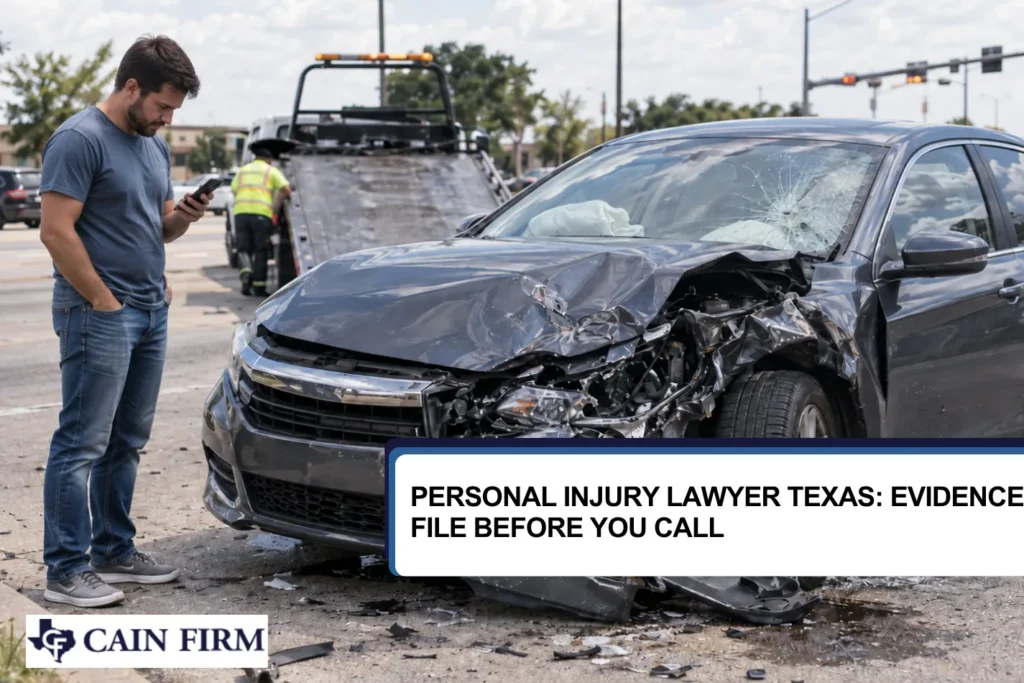
Start with a short accident timeline, photographs or videos, incident or police reports, witness information, medical paperwork, insurance communications, wage-loss records, and receipts. You do not need every document before scheduling a consultation, but an organized evidence file can help the lawyer identify liability, injuries, insurance issues, damages, and missing evidence more clearly.
Your consultation is tomorrow. You have photographs scattered across your phone, an insurance claim number buried in a text message, medical bills in three different envelopes, and no idea where the police report went. You know what happened, but explaining it clearly to a personal injury lawyer suddenly feels harder than it should.
You do not need a perfect legal file before asking for help. You also should not delay a consultation simply because some records are missing. But organizing the evidence you already have can help an injury lawyer understand the accident, identify missing proof, spot deadlines, and evaluate the case more efficiently.
That matters in Texas in 2026 because evidence can disappear long before the legal filing deadline arrives. Witness memories fade, surveillance footage may be overwritten, vehicles get repaired, and insurance conversations add up quickly. The State Bar of Texas specifically recommends organizing your materials and preparing a written account before meeting with a lawyer.
This guide shows you exactly what to collect, how to organize it, and what not to worry about before your first consultation.
Why an Evidence File Helps a Personal Injury Lawyer Evaluate Your Case
A consultation is not just about answering the question, “Were you hurt?” A personal injury lawyer needs to understand four broader issues: what happened, who may be legally responsible, how the event caused your injuries, and what losses followed.
Your evidence file helps turn a stressful story into a usable chronology.
The four questions an injury lawyer is trying to answer
A first review usually focuses on:
- Liability: Who caused or contributed to the incident?
- Causation: Did the accident cause or worsen the medical condition?
- Damages: What medical, financial, physical, and personal losses resulted?
- Recovery sources: What insurance policies or responsible parties may be available?
A fifth issue is timing. Your personal injury attorney needs to know when the incident happened because Texas filing deadlines and other notice requirements can affect your options.
Organized does not mean perfect
Do not spend months trying to build a flawless file before speaking with a lawyer.
If all you currently have is a photograph, discharge paperwork, and an insurance claim number, bring those. A Texas personal injury lawyer can tell you what matters next and what the firm can obtain independently.
The goal is to make the first conversation more productive, not to investigate the entire case yourself.
The State Bar of Texas advises people preparing for an initial lawyer meeting to organize their materials, prepare a written account of the problem, be candid about favorable and unfavorable information, keep their own files, and prepare questions.
Quick tip: Make one folder on your phone or computer called “Accident File.” Inside it, create separate folders for Scene, Medical, Insurance, Work, Expenses, and Contacts.
That simple system makes the next step much easier: building a reliable timeline.
Start With a One-Page Accident Timeline
Before sorting hundreds of pages, write down the story while it is still fresh.
A one-page timeline may be the most useful thing you bring to a personal injury lawyer because it lets the attorney understand the sequence before reviewing the supporting documents.
What to include in the timeline
Start with the basics:
- Date of the accident
- Approximate time
- Exact location
- What you were doing immediately beforehand
- How the accident happened
- What happened immediately afterward
- Names of people you spoke with
- When police, EMS, management, or security arrived
- When pain or symptoms began
- First medical appointment
- Follow-up treatment
- Dates you missed work
- Dates the insurer contacted you
Keep it factual. You do not need legal conclusions.
Instead of writing, “The store was completely negligent,” write, “I slipped near the freezer aisle. I saw liquid on the floor after I fell. I did not see a warning cone.”
That difference matters because your injury lawyer can apply the law after understanding what you actually observed.
Include uncertainty
Do not fill memory gaps with guesses.
Write:
- “I do not remember the exact speed.”
- “I think the light was green, but I need to confirm.”
- “I did not see where the liquid came from.”
- “I am unsure how long the hazard was there.”
An honest uncertainty is more useful than a confident statement that later turns out to be wrong.
Add a contact sheet
Below the timeline, list everyone connected to the event:
- Witnesses
- Police officers
- Property employees
- Supervisors
- Doctors
- Physical therapists
- Insurance adjusters
- Tow companies
- Employers
Someone looking for a personal injury lawyer near them often assumes they must know which witnesses matter. You do not. Save the contact information and let counsel decide.
Real-world example: A witness who seemed unimportant because they arrived seconds after a crash may have seen the other driver using a phone moments beforehand.
Once the timeline exists, begin matching it with independent evidence.
Build the Liability Folder: Photos, Reports, Witnesses, and Scene Evidence
Liability means legal responsibility. Before compensation can be evaluated, a personal injury lawyer needs evidence showing how another person’s conduct may have contributed to the injury.
That evidence depends on the type of incident.
Photographs and video
Keep the original versions whenever possible.
For a vehicle crash, save photographs of:
- All vehicles
- Damage from several angles
- License plates
- Intersection layout
- Traffic signals and signs
- Skid marks
- Debris
- Weather and road conditions
- Visible injuries
For a premises liability case, photograph:
- The hazard itself
- The surrounding floor or walkway
- Lighting
- Warning signs, or the absence of signs
- Stairs and handrails
- Nearby cameras
- Store or apartment identifiers
Texas Department of Insurance guidance recommends photographing accident scenes, vehicles, damage, insurance information, driver’s licenses, and license plates. It also advises collecting witness information and keeping receipts connected to a claim.
Police and incident reports
For Texas traffic collisions investigated by law enforcement, a CR-3 Peace Officer’s Crash Report may be available through TxDOT to people who are directly involved or otherwise entitled to receive it. TxDOT currently charges $6 for a regular copy and $8 for a certified copy.
Do not panic if you have not ordered it yet. Give your personal injury attorney the report number, investigating agency, officer name, or any paperwork provided at the scene.
Also remember that TxDOT is generally the custodian of the crash report itself. Dash camera footage, photographs, field notes, and similar materials may need to be requested from the investigating agency.
Witness information
TDI specifically notes that independent witnesses can help establish fault when drivers disagree about what happened.
Save:
- Full name
- Phone number
- Short note describing what the person saw
Do not coach witnesses or repeatedly ask them to restate their account.
Why this matters in Texas
Those numbers do not prove an individual claim. They show why clear accident documentation remains important in a state handling a very large volume of crashes and injury claims.
After liability evidence comes the part of the file that often matters most to an injured person: the medical record.
Build the Medical Folder Without Waiting for Every Final Record
Many people delay calling a personal injury lawyer because they assume they must order their complete medical chart first.
Usually, that is unnecessary.
Bring what you already have. A law firm can explain whether additional records need to be requested later.
Start with the documents in your possession
Useful materials include:
- Emergency room discharge paperwork
- Urgent care records
- After-visit summaries
- Diagnostic imaging reports
- Prescription lists
- Physical therapy paperwork
- Specialist referrals
- Work restrictions
- Medical bills
- Insurance explanations of benefits
If a provider gave you a patient portal, download key documents into your evidence folder.
Create a medical treatment list
A simple spreadsheet or note can save time.
Include:
| Provider | First Visit | Treatment | Next Appointment |
|---|---|---|---|
| Emergency room | [Date] | Initial evaluation | None |
| Orthopedist | [Date] | Neck and back evaluation | [Date] |
| Physical therapy | [Date] | Rehabilitation | [Date] |
You do not need to diagnose yourself.
Your injury lawyer needs to know where you received care, when treatment began, whether there are gaps, and whether doctors have recommended future treatment.
Document delayed symptoms accurately
If headaches began two days later or back pain worsened over the first week, note that in the timeline.
Do not rewrite history to make symptoms appear immediate. Medical records and testimony must remain consistent with what actually happened.
Preexisting conditions should not be hidden
Tell the personal injury attorney about prior injuries, surgeries, chronic pain, earlier claims, or similar symptoms.
A prior condition does not automatically eliminate a case. It may, however, affect causation and the way medical evidence needs to be analyzed.
Mistake to Avoid: Do not remove unfavorable records from the file because you think they hurt your case. A lawyer needs both helpful and difficult facts to evaluate risk accurately.
Someone searching for a personal injury lawyer for medical bills may be focused on the amount owed. The attorney will also want to understand whether treatment is related to the accident, whether more care is expected, and whether insurance or reimbursement rights may affect the claim.
You do not need a perfectly organized medical chart before asking for help. Cain Firm offers free consultations so injured Texans can discuss the available records, missing evidence, and next steps without waiting for every bill to arrive.
Medical documentation shows part of the loss. Your evidence file should also show how the injury affected your income and household finances.
Document Lost Wages, Expenses, and the Financial Impact of the Injury
A personal injury lawyer cannot accurately assess financial losses using medical bills alone.
If an injury caused you to miss work, reduce your hours, use vacation time, turn down overtime, or change jobs, document that impact.
Lost wage file
Collect what you can:
- Recent pay stubs
- W-2 or 1099 forms
- Employer contact information
- Written work restrictions
- Attendance records
- Dates missed
- Disability paperwork
- Records of lost bonuses or commissions
If you are self-employed, save:
- Invoices
- Contracts
- Tax returns
- Appointment calendars
- Customer cancellations
- Business financial records
A personal injury lawyer evaluating a lost-income claim may later need more detailed verification, but these documents give the attorney a starting point.
Keep an accident expense log
Small expenses disappear from memory quickly.
Track:
- Prescription copays
- Medical equipment
- Parking at medical appointments
- Transportation expenses
- Temporary help at home
- Replacement services
- Property-related costs
Keep receipts rather than estimating later.
Texas Chapter 41 defines economic damages as compensatory damages intended to compensate actual economic or pecuniary loss. Texas law separately recognizes noneconomic damages as another category of compensatory loss.
Record changes to daily life
Your financial documents tell only part of the story.
Keep brief notes about major limitations, such as:
- Cannot lift a child
- Cannot drive
- Sleeping only a few hours
- Unable to exercise
- Need help with household tasks
- Missed significant family activities
- Cannot perform normal job duties
Do not turn this into a daily essay. A simple, honest record is more useful.
Quick tip: Date your entries. Notes written close to the event are generally easier to explain later than memories reconstructed months afterward.
The next folder should capture what the insurance companies have already said and requested.
Save Every Insurance Document and Communication
Insurance paperwork can reveal deadlines, coverage issues, disputed facts, and statements that may later matter.
A personal injury lawyer for insurance claim issues will usually want to see the full communication history rather than one settlement offer taken out of context.
Save these insurance records
Keep copies of:
- Claim confirmation letters
- Claim numbers
- Adjuster names and contact information
- Emails and text messages
- Recorded statement requests
- Medical authorization forms
- Property damage estimates
- Settlement offers
- Denial letters
- Reservation-of-rights letters
- Your own policy declarations page
If you have uninsured or underinsured motorist coverage, medical payments coverage, or another relevant policy, save those documents too.
Create a communication log
Write down:
- Date
- Company
- Person
- Method of communication
- What was discussed
- What they requested
- What you sent
TDI recommends recording when you contacted the insurer, who you spoke with, the adjuster’s name, and what information the company requested.
Do not alter or delete communications
A message that feels unimportant now may help establish when the company received notice or what an adjuster previously said.
Save voicemails when possible.
Be careful with forms you do not understand
Do not sign a medical authorization, release, settlement agreement, or other document merely because an adjuster says it is routine.
Ask what the form does and keep a copy.
The State Bar of Texas similarly advises people to read documents carefully and ask a lawyer to explain anything they do not understand before signing.
Mistake to Avoid: Do not organize the file by deleting messages that make you uncomfortable. Your personal injury lawyer needs the real record, not a cleaned-up version.
With the main evidence folders assembled, the next challenge is avoiding mistakes that accidentally weaken or erase useful information.
Common Evidence Mistakes to Avoid Before Your Consultation
You do not need to become an investigator before meeting an injury lawyer. In fact, doing too much can sometimes create problems.
Focus on preserving what already exists.
1. Waiting for every document before calling
You can begin a personal injury consultation even if the crash report, final bills, or imaging records have not arrived.
Waiting can cost more than incomplete paperwork.
2. Editing original photographs
Do not crop, filter, annotate, or overwrite your only copy.
Make duplicates if you need versions with arrows or notes.
3. Throwing away damaged property
A torn helmet, damaged shoe, broken product, child seat, or damaged vehicle component may become relevant evidence.
Ask before disposing of physical items connected to the incident.
4. Posting your evidence publicly
Sending accident photos to your attorney is different from posting them on social media.
Public comments about fault, injuries, settlement expectations, or daily activities can complicate a claim.
5. Contacting hostile witnesses repeatedly
Save the witness’s information and let the attorney decide how to approach them.
6. Guessing when you cannot remember
An honest “I don’t know” is preferable to creating a fact that later conflicts with video, records, or another witness.
7. Hiding prior accidents or claims
Your personal injury lawyer should be given facts that may create defenses or otherwise affect the claim.
A lawyer cannot prepare for something you deliberately conceal.
8. Sending sensitive records through insecure channels
Medical, financial, and identity information can be highly sensitive.
Ask the law firm how it wants records submitted. Use the firm’s secure portal or approved intake process if one is available.
How a Texas Personal Injury Case Evaluation Works Step by Step
The purpose of a consultation is to discuss the facts, identify issues that may require further investigation, and determine whether the matter may be appropriate for representation.
Step 1: Basic intake
The firm usually asks for:
- Name and contact information
- Accident date
- Accident location
- Incident type
- Injury description
- Treatment status
- Insurance information
- Whether another attorney represents you
Typical timing: Often completed before or at the beginning of the consultation.
Step 2: Conflict review
The firm may need to confirm that it can ethically evaluate or accept the matter.
Step 3: Your factual account
The attorney or legal team reviews what happened.
This is where your one-page timeline helps.
Step 4: Liability analysis
The personal injury lawyer considers potential negligence, responsible parties, disputed fault, and evidence still available.
Texas cases may also require analysis of proportionate responsibility.
Step 5: Injury and causation review
The attorney examines:
- Symptoms
- Diagnoses
- Treatment
- Preexisting conditions
- Treatment gaps
- Future care
Step 6: Damages review
This may include:
- Medical expenses
- Lost wages
- Future earning issues
- Physical limitations
- Other legally recoverable losses
Step 7: Insurance and recovery review
A serious injury lawyer Texas families contact may need to identify more than one insurance policy or responsible business before deciding whether the case can be pursued effectively.
Step 8: Missing evidence list
This is one of the most useful outcomes of the consultation.
The attorney may say, for example:
- We need the crash report.
- We should preserve surveillance video.
- We need the employer’s wage verification.
- We need your prior medical records.
- We should identify another insurer.
Step 9: Representation decision
Not every consultation results in representation.
The lawyer may accept the case, decline it, refer it, request more information, or explain why additional investigation is necessary.
A Texas personal injury lawyer should not promise a result before the available evidence supports one.
Cain Firm’s current public materials state that the firm handles Texas personal injury matters, offers free consultations, and represents qualifying clients on a contingency-fee basis. The firm is rooted in Fort Worth and Granbury and serves injured people throughout Texas.
Texas Rules That Make Early Evidence Collection Important
Texas gives many injured people time to bring a lawsuit, but that does not mean waiting is harmless.
Evidence has its own timeline.
The general two-year limitation period
Texas Civil Practice and Remedies Code Section 16.003 generally requires a personal injury lawsuit to be filed no later than two years after the cause of action accrues. Wrongful death claims generally also fall under a two-year rule measured from the death, subject to statutory exceptions and other case-specific rules.
That is an outside legal deadline for many claims. It is not a recommended waiting period.
Texas proportionate responsibility
Under Texas Chapter 33, a claimant whose percentage of responsibility is greater than 50 percent generally may not recover damages.
That rule makes fault evidence valuable.
Photos, witnesses, video, reports, and physical evidence may affect whether an insurer or jury assigns part of the responsibility to you.
Evidence can disappear before the statute runs
Examples include:
- Surveillance footage may be overwritten under a property’s retention practices.
- Vehicles repaired
- Hazards corrected
- Electronic records deleted under retention schedules
- Witnesses moving
- Memories fading
A Texas personal injury lawyer may therefore recommend preservation activity well before any lawsuit is filed.
Your records can also protect against insurance disputes
TDI advises drivers to save witness details, police report information, photographs, videos, receipts, and claim communications.
That is practical advice even before you know whether litigation will become necessary.
The best evidence file does not prove every legal element by itself. It gives your attorney enough structure to identify what should be obtained next.
Common Questions About Preparing for a Personal Injury Consultation
What should I bring to a personal injury consultation?
Bring whatever you already have, especially photographs, videos, accident or incident reports, medical paperwork, insurance correspondence, witness information, pay records, and receipts. A short written timeline is also extremely helpful. The State Bar of Texas recommends getting organized and preparing written notes before meeting with a lawyer. You do not need to delay the consultation because some records are still missing.
Do I need my complete medical records before calling a personal injury lawyer?
No. Bring discharge papers, bills, portal records, imaging reports, and provider names that you already possess. A personal injury lawyer can identify what additional records may be necessary after learning the facts. Waiting months for a complete chart can create avoidable delays, especially when other evidence may need to be preserved quickly.
What evidence does an injury lawyer need to evaluate fault?
Useful liability evidence includes scene photographs, videos, police or incident reports, witness information, vehicle damage, property conditions, insurance details, and a clear timeline. Depending on the case, your injury lawyer may later seek surveillance footage, electronic data, maintenance records, employment records, or expert analysis.
Can a personal injury lawyer evaluate my case if I do not know who was at fault?
Yes. Determining fault is part of the legal evaluation. Do not assume you have no case because the insurer blames you or because several parties may share responsibility. Texas uses proportionate responsibility, which means fault can sometimes be divided among several people or entities. The attorney needs the available facts and evidence before reaching a conclusion.
Should I bring unfavorable evidence to my consultation?
Yes. Give the lawyer the complete picture. That includes prior accidents, earlier injuries, difficult text messages, unfavorable photographs, traffic citations, treatment gaps, or anything else that could later emerge. A personal injury attorney is better able to evaluate risk when the consultation includes both good and bad facts.
Frequently Asked Questions
Q: What if I only have photos and an insurance claim number right now?
A: Call anyway. Those materials are enough to begin a conversation. A personal injury lawyer can explain which additional documents matter and what the law firm may be able to obtain. Do not let an incomplete evidence folder become a reason to delay when footage, witnesses, or legal deadlines may require attention.
Q: Should I bring original documents or copies?
A: Copies or electronic versions are usually easier for an initial consultation. Keep important originals in a safe place unless the firm specifically asks for them. For photographs and videos, preserve the original digital files because metadata and image quality may later matter. Ask the law firm how it prefers sensitive records to be submitted.
Q: Can a personal injury lawyer help if medical bills are already going to collections?
A: A personal injury lawyer can review how the medical bills relate to the injury claim and discuss available options, but representation does not automatically stop collection activity or erase medical debt. Bring bills, collection notices, health insurance information, and any medical payment coverage so the lawyer can understand the full financial picture.
Q: What documents should I bring if I lost income because of the accident?
A: Bring pay stubs, tax documents, employer contact information, medical work restrictions, missed-work dates, disability paperwork, and records showing commissions or overtime that were lost. Self-employed clients should bring invoices, contracts, calendars, tax returns, or other business records. A personal injury lawyer for lost wages may request additional verification later.
Q: Is a free personal injury consultation in Dallas different from consultations elsewhere in Texas?
A: The basic case-evaluation issues are similar throughout Texas: fault, causation, damages, insurance, and deadlines. A free personal injury consultation Dallas residents schedule may involve Dallas-specific courts, witnesses, or accident records, while consultations involving Arlington, Tyler, Waco, Amarillo, Granbury, Bellaire, Benbrook, Grand Prairie, or Irving may involve different local evidence sources.
Q: Does bringing an organized evidence file guarantee that a lawyer will take my case?
A: No. An organized file helps the personal injury lawyer evaluate the matter more clearly, but representation depends on the facts, liability, injuries, evidence, deadlines, available recovery sources, conflicts, and the firm’s case criteria. No attorney should promise a successful result simply because the documentation is well organized.
Bring What You Have, Then Let Cain Firm Help Identify What Is Missing
You do not need to arrive at a consultation with a finished lawsuit in a binder.
You need the truth, the records you already have, and a clear account of what happened. A personal injury lawyer can use that starting point to evaluate liability, medical evidence, insurance coverage, financial losses, deadlines, and the evidence that still needs to be preserved.
Cain Firm represents injured Texans in personal injury matters and serves communities including Dallas, Arlington, Irving, Tyler, Amarillo, Grand Prairie, Granbury, Waco, Bellaire, Benbrook, and locations across Texas. The firm offers free consultations and handles qualifying injury claims on a contingency-fee basis, subject to the written representation agreement.
Call Cain Firm today or schedule your free consultation in Fort Worth, Texas. Bring the evidence you already have. Our team can help you understand what may matter next while memories, records, photographs, and other proof are still available.
No law firm can guarantee a result, and past outcomes do not predict the outcome of a future case.


