
There is no fixed settlement amount. Compensation depends on whether negligence can be proven, the severity of the injuries, medical expenses, lost income, future treatment, comparative fault, and available insurance. A slip and fall attorney evaluates these factors before recommending whether a settlement offer reasonably reflects the documented losses.
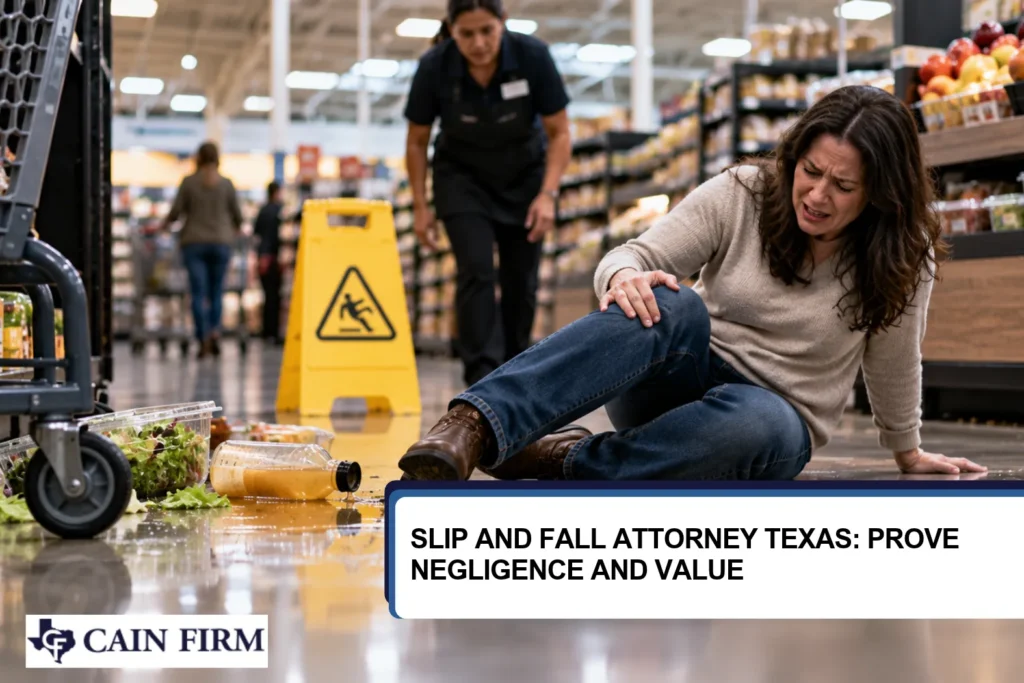
You walk into a grocery store to pick up a few things. Minutes later, you are on the floor, struggling to stand after slipping on liquid near a refrigerated display. An employee offers assistance, the manager prepares an incident report, and someone mentions that the store’s insurance company will contact you.
An incident report can document the accident and subsequent notification, but it does not, by itself, establish that the business knew or should have known about the dangerous condition before the fall.
Then the questions begin. Who pays your medical bills? Was the store negligent? What if nobody knows how long the liquid was there? And how much might your injury claim actually be worth?
A slip and fall attorney can help answer those questions by examining the dangerous condition, the property owner’s knowledge, your injuries, and the evidence supporting compensation.
Under Texas law, falling on someone’s property does not automatically make the owner responsible. A successful claim generally requires proof of a legally recognized duty, a dangerous condition, notice of that condition, and resulting harm.
In 2026, these cases remain especially evidence-sensitive because video recordings, inspection records, and witness information may disappear quickly.
This blog explains how Texas slip and fall settlements work, who may pay, and what you need to prove before negotiating compensation.
What Is Premises Liability Under Texas Law?
Premises liability is the area of law that addresses injuries caused by dangerous conditions on property.
People searching for what is premise liability or premise liability definition are generally looking for this concept. The correct legal term is premises liability, and it can apply to stores, restaurants, apartment complexes, hotels, offices, parking lots, and other properties.
A premises liability lawyer evaluates whether someone who owned, occupied, or controlled the property had a legal duty to protect the injured visitor from the specific hazard.
Common conditions that cause slip and fall injuries
Dangerous conditions may include:
- Spilled liquids in grocery stores
- Wet floors without adequate warnings
- Loose entrance mats
- Uneven walking surfaces
- Broken stairs or handrails
- Poor lighting
- Slippery restaurant floors
- Leaking refrigeration equipment
- Obstructed walkways
However, not every uneven surface, wet area, or ordinary floor condition creates legal liability.
Why the visitor's legal status matters
Texas distinguishes among different categories of property visitors.
An invitee, such as a customer shopping in a store, is generally owed reasonable protection from dangerous conditions the owner knows or should know about.
A licensee, such as certain social guests, may be owed a different duty. Trespassers generally receive more limited protection, subject to exceptions.
These distinctions can change the legal analysis substantially.
Premises liability is broader than slipping
A premises liability lawyer Texas residents contact may also handle injuries involving falling merchandise, defective stairs, dangerous walkways, and other property conditions.
Claims involving foreseeable criminal attacks may require a different legal analysis. For example, a negligent security lawyer may investigate inadequate security, previous similar crimes, and whether the property operator had a duty to take protective measures.
That is different from proving a grocery store knew about liquid on the floor.
The distinction matters because identifying the correct legal theory is the first step toward understanding whether compensation may be available.
Why Slip and Fall Settlements Depend on More Than Medical Bills
An injured shopper may assume that a store’s insurance company will pay the medical bills once it receives an incident report.
That is not necessarily how Texas premises liability claims work.
A store or property operator can dispute responsibility even when the accident clearly happened on its premises.
A slip and fall settlement requires a supported claim
A slip and fall settlement is usually an agreement resolving disputed injury claims in exchange for payment and a release of specified legal rights.
The amount may reflect several considerations:
- Whether the property operator was negligent
- Whether the dangerous condition caused the fall
- Whether the injured person shares responsibility
- The extent of documented injuries
- Past and future medical expenses
- Lost income
- Available insurance coverage
- The risks and costs of litigation
An insurer may make an early offer before the medical picture is complete. That offer may not account for future treatment or lasting limitations.
Who actually pays?
Depending on the facts, payment may come from a property owner’s or business operator’s liability insurer, the responsible party directly, or another entity that shares legal responsibility.
Potential defendants can include a store operator, property manager, tenant, maintenance contractor, or property owner.
Ownership alone does not automatically establish liability. The relevant question often involves who controlled the area, created the hazard, or had the legal duty to address it.
What about a slip and fall at Walmart?
A slip and fall at Walmart follows the same fundamental Texas premises liability principles as a fall at another retailer.
A major retailer does not become automatically responsible just because an injury happened inside the store.
The Texas Supreme Court’s decision in Wal-Mart Stores, Inc. v. Reece, 81 S.W.3d 812 (Tex. 2002), illustrates the importance of proving that the store knew or reasonably should have known about the hazard.
Mistake to Avoid: Do not confuse an incident report with an admission of negligence.
Once you understand who might pay, the next question becomes whether the evidence can establish legal responsibility.
How Do You Prove a Store or Property Owner Was Negligent?
A Texas premises-liability claim involving a dangerous property condition requires proof of specific legal elements. Depending on the visitor’s status and the circumstances, these generally include the property’s actual or constructive knowledge of the condition, the unreasonable risk it created, a failure to exercise reasonable care, and proximate causation of the injury.
A premises liability lawyer will examine each one rather than assuming the accident itself proves negligence.
1. The store knew or reasonably should have known about the dangerous condition
This is often the hardest issue in a Texas slip and fall case.
Knowledge can be established in several ways:
- A store employee created the dangerous condition.
- The store actually knew about the condition.
- The condition existed long enough that reasonable inspection should have discovered it.
The third possibility is called constructive notice.
In Wal-Mart Stores, Inc. v. Reece, the Texas Supreme Court emphasized that an employee being near a spill does not, by itself, establish constructive notice.
Evidence concerning how long the hazard existed is especially important.
2. The condition created an unreasonable risk of harm
Not every inconvenience is an unreasonably dangerous condition.
The analysis may consider the substance involved, visibility, location, walking surface, lighting, customer traffic, and surrounding circumstances.
For example, a hidden liquid spill on a polished floor may present a different risk from an ordinary dry floor.
3. The owner failed to exercise reasonable care
Reasonable care may include cleaning a dangerous condition, providing an adequate warning, or taking other appropriate protective measures.
However, Texas generally does not make stores insurers of every customer’s safety.
The law asks whether the responsible party failed to take precautions required under the particular circumstances.
4. The failure caused the injury
This is called proximate causation.
The injured person must establish that the dangerous condition and failure to use reasonable care legally caused the claimed harm.
Medical records, witness accounts, photographs, and the accident timeline can all matter.
What if the hazard was open and obvious?
Under Texas law, a property owner or operator generally has no duty to warn an invitee about a dangerous condition that is open and obvious or already known to the invitee. However, the legal analysis can depend on the circumstances, including whether an exception to the general rule applies. In Austin v. Kroger Texas, L.P., the Texas Supreme Court discussed this rule and recognized circumstances in which an exception may apply. A premises liability claim should therefore be evaluated based on the specific facts, the condition involved, and the duties the law imposes.
What Evidence Should You Preserve After a Slip and Fall?
Evidence can determine whether a case moves forward.
The store may clean the floor within minutes, remove a defective mat, or repair a broken surface. Security recordings may also be overwritten.
Start with photographs and video
When safe, photograph:
- The exact location where you fell
- The substance or defect involved
- The surrounding floor
- Warning signs or their absence
- Nearby displays or equipment
- Your footwear
- Visible injuries
Take both close-up and wider photographs.
The wider views help show lighting, visibility, and where employees or customers were located.
Report the incident
Notify management and request that an incident report be prepared.
Record the manager’s name and the approximate time of the report. Ask how you can obtain a copy, although the business may not voluntarily provide every internal record.
Identify witnesses and cameras
Witnesses may know whether the condition existed before you fell or whether employees had already been alerted.
Surveillance footage may show how the spill occurred and how long it remained.
In Brookshire Bros., Ltd. v. Aldridge, 438 S.W.3d 9 (Tex. 2014), the Texas Supreme Court examined a slip and fall dispute involving surveillance footage that had been partly preserved and partly overwritten.
That decision demonstrates both the importance of video evidence and the fact that missing footage does not automatically establish liability.
Preserve medical evidence
Get appropriate medical attention and save treatment records.
Falls can cause fractures, ligament injuries, head injuries, and lasting mobility limitations.
If the store has already cleaned the area or you are concerned that surveillance footage may disappear, contact Cain Firm for a free consultation. Early review may help identify records and evidence that should be preserved before a claim develops further.
How a Slip and Fall Attorney Investigates and Builds Your Claim
A slip and fall attorney does more than negotiate with an insurance adjuster.
The attorney must evaluate whether the evidence supports a legally viable case and whether the losses can be documented.
Investigating the property condition
The lawyer may investigate:
- Cleaning and inspection procedures
- Maintenance records
- Previous complaints
- Employee witness accounts
- Surveillance footage
- Incident reports
- Responsibility for the accident area
- Contracts involving maintenance or property management
An attorney can also examine whether the store created the hazard or had actual or constructive notice.
Identifying the responsible company
The name on the storefront may not identify every party involved in maintaining the premises.
A shopping center, for example, may have a landlord, commercial tenant, property manager, and cleaning contractor.
Which party may be responsible depends on control, contractual duties, and the circumstances of the accident.
Reviewing injuries and financial losses
The attorney may gather:
- Medical records and billing information
- Lost wage documents
- Future treatment recommendations
- Employment restrictions
- Evidence of permanent limitations
- Insurance and reimbursement information
If the insurer denies responsibility, litigation may be necessary to obtain relevant records through discovery.
Local representation across Texas
Someone searching for slip and fall attorneys in Dallas Texas or a slip and fall lawyer Dallas often needs help with a retail or commercial-property injury.
People searching for slip and fall lawyers in Houston Texas may face similar legal questions, although the witnesses, location, and court proceedings differ.
The same Texas premises liability principles generally apply in Fort Worth, Amarillo, Arlington, Bellaire, Benbrook, Granbury, Grand Prairie, Irving, Tyler, and Waco.
Cain Firm handles premises liability and slip and fall matters from its Fort Worth-based practice and serves injured people throughout Texas.
A case review can help determine whether further investigation, negotiation, or litigation is appropriate.
Six Mistakes That Can Weaken a Texas Slip and Fall Claim
Small decisions after an accident can make important evidence harder to find.
Avoid these common mistakes.
1. Leaving without reporting the fall
You may be embarrassed or anxious to leave.
However, reporting the incident creates a record that the business was notified of what happened.
2. Failing to photograph the hazard
Liquid can be cleaned, objects removed, and broken surfaces repaired quickly.
Photographs may become the clearest evidence of the condition.
3. Assuming every fall creates a lawsuit
A dangerous condition, the defendant’s knowledge, a failure to use reasonable care, and causation still need to be established.
Being injured on commercial property alone does not prove liability.
4. Giving a recorded statement without preparation
An adjuster may ask whether you saw the hazard, where you were looking, or whether you have prior injuries.
Answering from incomplete memory can cause confusion later.
Do not guess.
5. Accepting compensation before understanding the medical condition
Before accepting a settlement, consider whether the available medical evidence adequately documents the injury, expected treatment, and potential long-term effects. The appropriate timing of settlement depends on the circumstances, and a signed release may limit the ability to seek additional compensation for the claims it resolves.
6. Waiting too long to preserve evidence
The legal filing period may be measured in years, but business video systems can overwrite footage much sooner.
A Texas slip and fall lawyer can help identify what records may matter and how to request their preservation.
Mistake to Avoid: Never exaggerate your symptoms or minimize legitimate problems. Accurate, consistent records are more useful than statements made to influence an insurance company’s reaction.
The next step is understanding what actually happens after a claim is opened.
How the Texas Slip and Fall Claim Process Works
The timeline depends on the injury, liability dispute, insurance coverage, and willingness of the parties to exchange information.
There is no universal settlement deadline.
Step 1: Report the incident and get medical care
Typical timing: Immediately after the fall.
Notify management, document the scene, obtain witness information, and seek appropriate treatment.
Step 2: Preserve important records
Typical timing: As soon as possible.
Save photographs, medical paperwork, receipts, and communications.
Counsel may seek preservation of surveillance footage and business records.
Step 3: Investigate legal responsibility
Typical timing: Weeks to months, depending on complexity.
A slip and fall attorney Texas residents contact may review the inspection history, property control, hazardous condition, and evidence of notice.
Step 4: Document the full injury
Continue medically recommended care.
The lawyer may gather updated records, wage-loss information, and evidence concerning long-term restrictions.
Step 5: Submit a supported settlement demand
Once the case can be evaluated responsibly, the lawyer may present a demand to the appropriate insurer or defendant.
Step 6: Negotiate
The insurer may accept some responsibility, reject the claim, dispute notice, challenge medical causation, or propose a lower amount.
Step 7: File a lawsuit if necessary
A lawsuit can provide formal procedures for requesting relevant information and obtaining testimony.
It does not mean every case will reach trial.
Step 8: Resolve the claim
The matter may end through settlement, mediation, court ruling, or trial.
A serious case may take longer when treatment continues or important liability questions remain unresolved.
Quick tip: Be cautious about any promise that your claim will settle within a specific number of weeks. The evidence and medical circumstances should drive the schedule, not an arbitrary deadline.
Texas also has filing rules that make early legal review particularly important.
Texas Deadlines, Comparative Fault, and Other Legal Rules
Several Texas statutes can affect both the right to sue and the amount of compensation available.
The general two-year filing deadline
Texas Civil Practice and Remedies Code Section 16.003 generally requires a personal injury lawsuit to be filed within two years after the claim accrues, subject to exceptions.
Missing the applicable deadline can prevent recovery.
Special rules for government-owned property
If a fall occurs on property owned or controlled by a governmental entity, the Texas Tort Claims Act and other applicable rules may affect the claim. Section 101.101 generally addresses notice within six months of the incident, but certain municipal charter provisions may require earlier notice. Exceptions may also apply. These notice requirements are separate from the applicable lawsuit filing deadline. Because missing a required notice deadline can affect a claim, prompt legal review is advisable.
Texas comparative responsibility
Under Chapter 33 of the Texas Civil Practice and Remedies Code, a claimant generally cannot recover damages if the claimant’s percentage of responsibility exceeds 50 percent.
If the claimant is 50 percent or less responsible, the recoverable amount may be reduced according to the assigned percentage.
A property insurer may argue that you were distracted, ignored a warning, or failed to notice an obvious condition.
The evidence, not the insurer’s assertion alone, should determine how those arguments are evaluated.
Medical expense recovery
Texas Civil Practice and Remedies Code § 41.0105 limits recovery of medical and healthcare expenses to amounts actually paid or incurred by or on behalf of the claimant, subject to applicable law. In Haygood v. De Escabedo, the Texas Supreme Court addressed the relationship between billed medical charges and recoverable medical expenses. The amount recoverable in an individual case depends on the applicable law and supporting evidence.
Are damages capped?
Texas generally does not impose one universal settlement cap on ordinary negligence claims against private stores.
However, special defendants, certain legal claims, exemplary damages, insurance limits, and other circumstances can create important limitations.
Mistake to Avoid: Do not use a settlement figure from another state or an unrelated lawsuit as a prediction of what Texas law will allow in your case.
With those rules in mind, the final question is how your particular damages should be evaluated.
How Much Compensation Can You Recover From a Slip and Fall?
People frequently search for the average slip and fall settlement, average slip and fall settlement in Texas, or how much is a slip and fall case worth.
The difficulty is that publicly available settlements are not a complete or standardized dataset.
There is no reliable universal Texas average that can predict the value of a specific slip and fall case.
Economic damages
Recoverable economic damages may include:
- Medical treatment
- Hospital expenses
- Rehabilitation
- Prescription costs
- Future medical care
- Lost wages
- Reduced earning capacity
- Other documented financial losses
Noneconomic damages
Depending on the injury and evidence, compensation may also be available for:
- Physical pain
- Mental anguish
- Physical impairment
- Disfigurement
- Loss of enjoyment of life
Can you settle without surgery?
Yes. Searches for slip and fall settlements without surgery in Texas reflect a common concern.
Surgery is not a legal requirement for compensation.
A person may have a significant injury requiring extensive therapy, injections, medication, or long-term restrictions without undergoing surgery.
The key questions involve diagnosis, causation, reasonable treatment, functional limitations, and the strength of the liability evidence.
What about knee injuries?
Someone researching a knee injury settlement average slip and fall may be dealing with a ligament tear, meniscus injury, fracture, or chronic knee pain.
These conditions can involve very different treatment needs.
A mild injury that resolves after a short course of care will generally be evaluated differently from an injury causing lasting mobility restrictions or reduced earning capacity.
What factors most affect settlement value?
A premises liability lawyer may consider:
- Evidence of actual or constructive notice
- Whether the condition was unreasonably dangerous
- The property’s control and maintenance history
- Whether you share responsibility
- Medical diagnosis and treatment
- Permanent impairment
- Future care needs
- Lost income
- Available insurance
- Litigation risk
A slip and fall settlement should reflect the evidence and applicable law, not a generic online calculator.
That is why a meaningful evaluation begins with proof of negligence before assigning a potential value to the claim.
Common Questions About Slip and Fall Settlements in Texas
What is the average slip and fall settlement in Texas?
There is no reliable statewide figure that accurately predicts the settlement value of an individual Texas slip and fall claim. Settlements may involve private agreements, and the results depend heavily on the facts. A slip and fall attorney will evaluate liability evidence, the property operator’s knowledge, injury severity, medical expenses, lost income, future care, and comparative responsibility. A severe injury does not necessarily produce a recovery if negligence cannot be proven.
Can you sue Walmart for a slip and fall in Texas?
Potentially, yes. However, a slip and fall at Walmart does not automatically make the retailer liable. Texas law generally requires evidence that the store created the dangerous condition, knew about it, or reasonably should have discovered it, along with proof of an unreasonable risk, inadequate response, and resulting injury. Wal-Mart Stores, Inc. v. Reece remains an important Texas Supreme Court decision addressing constructive notice.
What evidence is needed to prove premises liability?
Important evidence may include photographs of the dangerous condition, surveillance footage, witness statements, incident reports, cleaning records, inspection logs, prior complaints, and medical documentation. A premises liability lawyer may also investigate who controlled the area and how long the hazard existed. For a temporary spill, proof of notice is often central. Evidence created close to the time of the accident can be particularly useful.
Can I recover compensation if I was partly responsible for falling?
Possibly. Texas uses proportionate responsibility. If your share of responsibility is greater than 50 percent, you generally cannot recover damages under Chapter 33. If your responsibility is 50 percent or less, the recoverable amount may be reduced. However, questions about obvious hazards and the property operator’s legal duty can arise before comparative fault is considered, so the complete circumstances matter.
Frequently Asked Questions About Texas Slip and Fall Claims
Q: Should I contact a slip and fall attorney before speaking with the store’s insurer?
A: Legal advice can be particularly helpful when injuries are serious, the store disputes responsibility, video evidence may disappear, or the insurer requests a recorded statement or settlement release. A slip and fall attorney can review the available information and explain what further investigation may be needed. You should still report the incident and seek appropriate medical care promptly.
Q: Can I file a claim if no employee witnessed my fall?
A: Yes, a witness to the actual fall is not always required. Other evidence may establish the hazardous condition, notice, and causation. Video, employee records, cleaning logs, photographs, previous complaints, and witness testimony about the condition before the accident may be relevant. The absence of a direct witness can make proof more difficult, but it does not automatically defeat the claim.
Q: How are slip and fall attorney fees usually paid in Texas?
A: Many Texas personal injury firms use contingency-fee agreements, meaning attorney fees depend on obtaining a recovery under the signed agreement. The agreement should explain the percentage, litigation expenses, and how costs affect the client’s recovery. Cain Firm offers free consultations and contingency-fee representation for qualifying injury matters. Review the agreement carefully before signing.
Q: Can an apartment complex be responsible for a slip and fall?
A: Possibly. Responsibility depends on the dangerous condition, control of the area, the property’s legal duties, applicable lease provisions, knowledge of the hazard, and the injured person’s status. Common areas, stairs, walkways, and maintenance problems may raise different issues from conditions inside a tenant’s leased unit. A premises liability lawyer can evaluate which person or company had the duty to address the hazard.
Q: Do I need surgery to receive a slip and fall settlement?
A: No. Surgery is not required for a valid injury claim or settlement. However, medical treatment must be reasonably related to the injury, and the case must still satisfy the necessary liability elements. A person with a documented nonsurgical injury may recover compensation when the evidence supports the claim. The amount depends on actual losses, functional impact, fault, insurance coverage, and litigation risk.
Q: Does Cain Firm handle slip and fall cases outside Fort Worth?
A: Cain Firm handles premises liability and slip and fall injury matters in Texas, with its primary office in Fort Worth and additional appointment-based access in Granbury. The firm serves injured people across Texas, including Dallas, Arlington, Amarillo, Bellaire, Benbrook, Grand Prairie, Irving, Tyler, and Waco. Whether representation is available in an individual matter depends on the case evaluation.
Injured in a Store or on Someone Else's Property? Get Your Case Reviewed
A serious slip and fall can leave you with medical bills, lost income, pain, and uncertainty about whether anyone will accept responsibility. You deserve a clear explanation of what Texas law requires before deciding whether a settlement offer is reasonable.
Cain Firm helps injured Texans investigate dangerous property conditions, evaluate premises liability claims, preserve evidence, and understand their legal options. The firm offers free consultations and handles qualifying personal injury matters on a contingency-fee basis, subject to the written agreement.
Contact the Cain Firm to schedule your free consultation in Fort Worth, Texas today. Whether you need a slip and fall attorney or a premises liability lawyer, early review can help protect important evidence and identify deadlines that may affect your case.
No law firm can guarantee a result, and past outcomes do not predict the outcome of a future case.


