
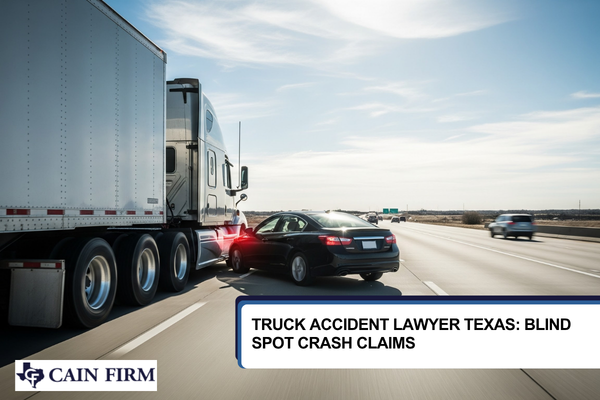
Blind spot and No-Zone truck accidents in Texas are often complex because visibility issues do not automatically excuse a truck driver or prove a passenger vehicle was at fault. A strong claim usually depends on Texas fault rules, police reports, witness accounts, lane-change evidence, and sometimes accident reconstruction.
A blind spot truck crash can look simple at first. A car and a tractor-trailer collide during a lane change, merge, or wide turn, and both drivers blame the other. But these cases are usually much more technical than they seem. The Federal Motor Carrier Safety Administration, or FMCSA, warns that large trucks have huge blind spots, called “No-Zones,” around the front, back, and sides of the vehicle. FMCSA also says that one-third of crashes between large trucks and cars happen in the No-Zone. That matters in any Texas injury claim because fault may depend on mirror checks, turn signals, lane position, speed, and whether the trucking company followed safe driving practices. If you are searching for a truck accident lawyer Texas victims can trust after a serious crash, understanding why these cases are different is the first step.
Why Blind Spot Truck Accidents Are More Complicated Than They Look
FMCSA explains that large trucks and buses have large blind spots, long stopping distances, and wide-turn limits. In real cases, that means a so-called simple sideswipe may actually involve several overlapping issues, including mirror use, following distance, truck speed, lane drift, signal timing, and whether the smaller vehicle was visible long enough for a careful truck driver to react. That is why a truck accident lawyer, truck accident attorney, or 18 wheeler accident lawyer will usually look beyond the first insurance story and dig into the full sequence of events.
Another layer of complexity is that No-Zone cases are often blamed on “visibility” alone. But visibility is only one piece of the puzzle. A truck driver may still be negligent for changing lanes without enough clearance, failing to monitor mirrors carefully, or making an unsafe right turn. A passenger vehicle driver may also face blame for riding beside the trailer too long, passing on the right at the wrong moment, or following too closely. In other words, these are often shared-fault cases, not simple one-party cases.
Understanding Texas Comparative Fault System
Texas uses a proportionate responsibility system. Under Texas Civil Practice and Remedies Code Chapter 33, a claimant cannot recover damages if their percentage of responsibility is greater than 50 percent. If they are 50 percent or less responsible, their damages can still be reduced by their share of fault. In blind spot truck accident cases, that rule matters a lot because insurers often argue that the passenger vehicle “stayed in the No-Zone” or “should have known better.” A Texas truck accident lawyer should be ready to challenge those arguments with evidence, not assumptions.
Why Comparative Fault Matters So Much in No-Zone Claims
This is where many truck cases get difficult. A trucking insurer may admit there was contact but still argue that the injured driver caused most of the crash by merging beside the trailer, lingering near the cab, or trying to pass during a wide turn. That is one reason truck accident lawyers often focus heavily on vehicle positioning, timing, and visibility evidence. In a serious injury case, even a small shift in fault percentage can change the value of the claim dramatically.
Key Factors That Determine Fault in Blind Spot Truck Accidents
Several facts usually matter most when determining fault after a blind spot or No-Zone crash:
- Whether the truck driver checked mirrors before changing lanes
- Whether either driver used a proper signal
- Whether the passenger vehicle was traveling in a known blind area
- Whether the truck made a wide right turn or unsafe merge
- Whether the smaller vehicle was following too closely
- Whether traffic, weather, or roadway design limited safe movement
Texas law requires drivers to signal when turning, changing lanes, or starting from a parked position. Texas law also requires drivers following another vehicle to maintain an assured clear distance so they can stop safely. Those traffic rules often become central in blind spot crash claims.
The Truck Driver’s Conduct
A semi truck accident lawyer will often examine whether the driver scanned mirrors often enough, drifted across lanes, made an abrupt merge, or tried to complete a turn without enough clearance. FMCSA’s safety materials emphasize that large trucks face unique challenges with blind spots, wide turns, and stopping distance, which is exactly why truck drivers are expected to operate carefully around surrounding traffic.
The Passenger Vehicle Driver’s Conduct
A defense lawyer will usually focus on whether the car driver stayed beside the trailer too long, passed on the right near an intersection or ramp, or drove in a position where the truck driver could not see them. FMCSA’s passenger vehicle guidance specifically warns drivers to stay out of the No-Zones and notes that if you cannot see the truck driver in the side mirror, you should assume the driver cannot see you either.
Common Types of Evidence Used to Prove Fault
Blind spot truck cases are won with detail. Helpful evidence often includes:
- The Texas Peace Officer’s Crash Report, or CR-3
- Photos of lane markings, debris, damage, and impact points
- Witness statements from nearby drivers
- Dash cam, traffic camera, or business surveillance footage
- Electronic data from the truck
- Driver logs, dispatch records, and maintenance records
- Cell phone data when distraction is suspected
For a Truck accident lawyer near me, the goal is to show exactly where each vehicle was, who moved first, and whether the crash could have been avoided with reasonable care.
The Role of Police Reports in Car Accident Cases
Even though this topic involves commercial trucks, the police report still plays the same foundational role it does in other serious vehicle cases. TxDOT explains that Texas Peace Officer’s Crash Reports, or CR-3 reports, are not available for general public viewing online, but qualifying people, including those directly involved in the crash and certain representatives, can request them through the Crash Report Online Purchase System. That report may capture lane-use facts, statements from drivers and witnesses, citations, roadway conditions, and the officer’s initial fault assessment.
The TxDOT crash report codesheet also includes categories that can matter in a truck case, including whether the vehicle was operating in interstate commerce, intrastate commerce, government use, or personal use. That detail can help identify the right trucking company, insurer, and possible commercial defendants early in the case.
How Witness Statements and Testimonies Can Impact Fault
Witnesses are especially important in No-Zone crashes because both drivers often tell very different stories. A neutral witness may be the only person who can say whether the truck signaled, whether the car was boxed in, whether the truck drifted, or whether the smaller vehicle tried to pass during a wide right turn. In a case that looks like a simple sideswipe on paper, that kind of testimony can completely change the liability picture.
This is also why early case work matters. People forget speeds, lane positions, and timing quickly. A Truck accident lawyer Dallas, Dallas Truck accident lawyer, or arlington Truck accident lawyer handling a serious blind spot crash should move fast to preserve witness details while memories are still fresh.
What Role Do Traffic Laws and Accident Reconstruction Play?
Traffic laws give the framework, but accident reconstruction often explains what really happened. Texas signal and following-distance laws can support a claim when one driver changed lanes without warning or followed too closely. Then reconstruction experts can use crush damage, yaw marks, debris, camera footage, and electronic data to estimate vehicle paths, lane overlap, and the timing of evasive action. In a disputed No-Zone case, that kind of analysis can help show whether the truck began moving into an occupied lane or whether the passenger vehicle entered a space that was never safely open.
What to Do After a Truck Accident
If you are wondering what to do after a truck accident, take these steps as soon as you can:
- Call 911 and request police and medical assistance
- Get medical treatment, even if symptoms seem delayed
- Photograph vehicle damage, skid marks, lane markings, and the truck’s markings
- Get names and contact information for witnesses
- Do not give a recorded statement to the trucking insurer without preparation
- Request or preserve the CR-3 Report information
- Speak with a Truck accident lawyer or truck accident attorney before accepting an early offer
These steps protect both your health and your evidence. TxDOT’s crash-report system can become an important part of the claim once the initial emergency has passed.
Mistakes to Avoid After a Blind Spot Truck Crash
Avoid these common mistakes:
- Assuming the truck driver is automatically at fault
- Assuming the car driver is automatically at fault
- Delaying medical care
- Failing to photograph lane position and side damage
- Posting about the crash on social media
- Talking too freely with insurance adjusters
- Waiting too long to contact counsel
A blind spot crash is one of those cases where small facts matter. What looks like a routine insurance claim may actually need a Fort Worth Truck accident lawyer to sort out visibility, timing, and fault.
Common Legal Terms in These Cases
Here are a few legal terms readers often need explained:
- Comparative fault: Shared responsibility for the crash
- No-Zone: The large blind spot areas around a commercial truck
- Negligence: Failure to use reasonable care
- Damages: Money sought for medical bills, lost income, pain, and other losses
- CR-3 Report: The Texas Peace Officer’s Crash Report
- Accident reconstruction: Expert analysis of how the crash happened
These terms matter because blind spot truck cases are rarely decided by one fact alone.
FAQs
Are blind spot truck accidents always the fault of the car driver?
No. FMCSA warns that large trucks have major blind spots, but that does not excuse unsafe lane changes, poor mirror checks, or careless turns. A Truck accident lawyer texas or semi Truck accident lawyer will look at the full evidence before reaching a conclusion.
Should I search for a Truck accident lawyer near me after a No-Zone crash?
Yes, especially if the crash caused serious injuries or there is a dispute about lane position or fault. If you are comparing a Truck accident lawyer near me, truck accident attorney near me, or Truck accident lawyers near me, look for a firm that understands commercial-truck evidence, police reports, and comparative fault issues.
Can I still recover money if the insurer says I was partly in the truck’s blind spot?
Possibly. Texas law still allows recovery when your percentage of responsibility is 50 percent or less, although your damages can be reduced by your share of fault. That is why many injured people speak with a truck accident attorney fort worth, fort worth truck accident attorney, or Truck accident lawyer dallas before responding to the insurer.
Schedule a Consultation With a Texas Truck Accident Lawyer
Blind spot truck crashes are rarely as simple as they first appear. If you need a Truck accident lawyer, truck accident attorney, Truck accident lawyer Texas, or Texas Truck accident lawyer after a serious No-Zone collision, experienced legal guidance can make a real difference. Our team at The Cain Firm helps injured people evaluate claims involving lane changes, wide turns, mirror checks, and disputed fault. Whether you are looking for a Fort Worth Truck accident lawyer, Truck accident lawyer Fort Worth, truck accident attorney Fort Worth, Dallas Truck accident lawyer, Truck accident lawyer Dallas, or Arlington Truck accident lawyer, we are here to help you understand your options and protect your claim.
This article is for informational purposes only and does not constitute legal advice. Reading this content does not create an attorney-client relationship


