
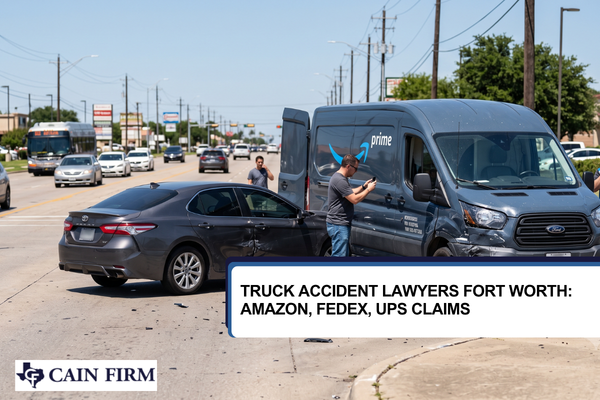
Who handles an Amazon, FedEx, or UPS delivery vehicle accident claim in Texas? The answer depends on who actually employed or contracted with the driver, who owned or operated the vehicle, what delivery program the driver was working under, and which liability policy covered the trip. The company logo alone does not establish who is legally responsible, so the driver’s employment records, vehicle information, insurance documents, and delivery assignment should be investigated.
You see the Amazon smile, FedEx logo, or familiar brown UPS truck immediately after the crash. It seems obvious who should receive the insurance claim. Then the calls begin, and suddenly you hear about a local delivery company, an independent contractor, a service provider, a different corporate entity, or an insurer you have never heard of.
That confusion is not unusual.
For Fort Worth drivers seeking legal help after a delivery crash, identifying the correct company can be one of the first major issues in the case. Amazon currently uses Delivery Service Partners and independent Amazon Flex drivers. FedEx operates with both company employees and thousands of independent service providers. UPS, by contrast, reports a large employee workforce that includes workers who handle and transport packages.
In 2026, the logo on the vehicle is therefore only the beginning of the investigation. This guide explains who may actually handle the claim, what insurance may apply, what evidence identifies the responsible business, and why early investigation matters.
Who Actually Handles an Amazon, FedEx, or UPS Delivery Truck Claim?
Delivery networks no longer use one simple employment model. Two drivers wearing similar uniforms or delivering packages for the same brand may have very different employers and insurance coverage.
That distinction can determine where the injury claim should be sent.
Amazon Delivery Service Partner drivers
Amazon states that its Delivery Service Partner, or DSP, program works with independent businesses that hire and manage their own drivers. Amazon provides DSPs with technology, infrastructure, and other services, but the individual delivery company generally hires the driver.
That means a crash involving an Amazon-branded van may initially involve:
- The delivery driver
- The driver’s DSP employer
- The DSP’s commercial auto liability coverage
- Other entities whose conduct contributed to the crash
Whether Amazon itself has legal responsibility requires a fact-specific analysis. A commercial truck accident lawyer should not assume either that Amazon is automatically liable or that Amazon can never be liable.
Amazon Flex drivers
Amazon Flex is different. Amazon describes Flex drivers as independent contractors who use their own vehicles and choose delivery blocks. Amazon’s current U.S. Flex FAQ says drivers must maintain required personal insurance and that Amazon provides commercial auto insurance in states other than New York while the Flex driver is actively delivering during a delivery block.
A Texas Amazon Flex collision may therefore involve the driver’s own policy, Amazon’s Flex commercial policy, or both depending on the claim and coverage terms.
FedEx delivery drivers
FedEx’s current model also requires investigation. FedEx reported that its FY2025 U.S. network included approximately 375,000 employees and 5,700 independent service providers. FedEx has also stated that packages are delivered by both FedEx-employed couriers and employees of independent service providers.
A FedEx logo does not by itself tell you whether the driver worked directly for FedEx or for a contracted company.
UPS delivery drivers
UPS reported approximately 460,000 employees worldwide for 2025, including about 370,000 in the United States. Nearly 80 percent of its U.S. employees were union represented, primarily workers handling or transporting packages.
A traditional UPS delivery vehicle is therefore often a different liability situation from an Amazon DSP or Flex delivery. Even so, the driver’s exact employer and vehicle operator should still be confirmed rather than assumed.
Why the Logo on the Delivery Van May Not Identify the Responsible Company
When people search for truck accident attorneys near me after a delivery collision, they often believe the first task is contacting Amazon, FedEx, or UPS customer service. That may not identify the insurer responsible for an injury claim.
A delivery network can involve several separate legal relationships.
Branding and employment are not the same thing
A van may display Amazon branding while being operated by a DSP. A FedEx package can be delivered by a FedEx-employed courier or by an employee of an independent service provider. An Amazon Flex driver may arrive in an ordinary passenger vehicle with little or no visible branding.
That makes questions like these critical:
- Who issued the driver’s paycheck?
- Who owned or leased the vehicle?
- Who maintained the vehicle?
- Whose USDOT number was displayed?
- Who provided the delivery route?
- Who carried the commercial auto policy?
- Was the driver actively making deliveries?
- Was another contractor involved?
The claim administrator may be another company
Even after the correct business is found, the person handling the claim may work for an insurance carrier or third-party claims administrator rather than the delivery company.
This is why calling the general Amazon, FedEx, or UPS customer-service line may not move an injury claim forward. The correct notice often needs to reach the business entity and liability carrier connected to the vehicle and driver.
Why this matters financially
If the wrong entity receives the claim, valuable time can be lost while evidence changes or disappears.
The difference is particularly important in delivery crashes involving:
- Serious injuries
- Several vehicles
- Pedestrians or cyclists
- Commercial vans
- Box trucks
- Tractor-trailers
- Disputed driver status
Real-world scenario: A driver is hit by a van displaying Amazon logos in Arlington. The police report later identifies a local DSP as the motor carrier. The claim investigation therefore needs to examine that company’s insurance and employment records, not simply send a demand addressed to Amazon.
The logo identifies the delivery network. It does not always identify the defendant.
What Legal Factors Determine Who May Be Responsible for the Crash?
A Fort Worth truck accident attorney evaluating a delivery crash usually begins with negligence and agency law.
Negligence means failing to use reasonable care. Agency and employment rules determine when one person or company may be responsible for another person’s conduct.
The driver's negligence
The driver’s conduct remains central. Relevant issues may include:
- Speeding
- Distracted driving
- Running a traffic signal
- Following too closely
- Unsafe backing
- Parking in a dangerous location
- Failing to yield
- Unsafe lane changes
Employer responsibility
Texas recognizes vicarious liability, often described by the Latin phrase respondeat superior. In plain English, an employer may be responsible for an employee’s negligent conduct when the employee was acting within the course and scope of employment.
The Texas Supreme Court has explained that proving vicarious liability requires establishing both the employment relationship and that the worker was acting within the course and scope of that employment when the crash occurred.
This becomes especially important with Amazon DSP and FedEx service-provider drivers because the company whose logo appears on the van may not be the driver’s direct employer.
Independent contractor issues
Calling someone an independent contractor does not automatically answer every liability question. Courts can examine the actual legal relationship, applicable contracts, control, and duties involved.
That does not mean the shipping brand becomes liable whenever a contractor crashes. It means an investigation should start with evidence rather than assumptions.
Vehicle and maintenance responsibility
A crash can also involve negligent maintenance, defective brakes, worn tires, unsafe loading, or another mechanical problem. Texas commercial vehicle law specifically preserves certain claims involving an employer’s own conduct, such as negligent maintenance, even when other employer-negligence theories are limited by statute.
Quick tip: If you were injured in a branded delivery-vehicle collision in Fort Worth, preserve the vehicle number, license plate, USDOT markings, and driver information before focusing on the logo.
Those details help identify the legal relationships that matter.
What Evidence Can Reveal Who Employed, Insured, and Controlled the Driver?
Important evidence in a delivery vehicle case can often be collected at the scene.
That evidence can help identify the businesses, insurers, and other parties that should be investigated.
Evidence to collect immediately
If it is safe to do so, document:
- The delivery vehicle from every angle
- Company and contractor names on the doors
- License plate
- USDOT or motor-carrier numbers
- Vehicle or unit number
- Driver’s license and insurance information
- Driver badge or employer information
- Packages or delivery equipment visible inside
- Skid marks and debris
- Nearby cameras and witnesses
TxDOT states that Texas officers generally must submit a crash report when an investigated collision causes injury, death, or at least $1,000 in apparent property damage. TxDOT keeps the official CR-3 crash report, while photographs, dash-camera footage, and field notes generally remain with the investigating agency.
Use the USDOT number, not just the brand
FMCSA’s SAFER Company Snapshot allows the public to search a carrier by USDOT number, MC/MX number, or company name. The database can identify the carrier’s legal name, size, operating status, and safety information.
That can be especially helpful when the crash report lists a company you have never heard of.
Evidence the company may control
A lawyer may seek preservation of:
- Delivery route records
- Dispatch messages
- Driver schedules
- Vehicle telematics
- Camera recordings
- GPS data
- Training records
- Employment or contractor agreements
- Maintenance files
- Driver qualification documents
- Electronic logging information where applicable
Amazon has publicly described camera-based safety technology in branded delivery vans and technology used to monitor unsafe driving behavior. That makes preservation requests particularly relevant in some Amazon DSP cases.
Mistake to Avoid: Do not assume a company will preserve every electronic record indefinitely simply because a claim might eventually be filed.
How a Commercial Truck Accident Lawyer Investigates a Delivery Crash
People searching for legal help after a delivery-vehicle crash usually need more than help completing an insurance form.
The first legal task is often identifying every relevant party.
Stage 1: Identify the driver and employer
A commercial truck accident lawyer can compare the police report with corporate registrations, carrier records, vehicle information, employment documents, and insurance data.
For Amazon, that may mean determining whether the driver was:
- A DSP employee
- An Amazon Flex contractor
- Another delivery partner
- Operating a larger vehicle for a separate carrier
For FedEx, the lawyer may need to determine whether the driver was a FedEx employee or worked for one of the independent service providers used in its network. FedEx itself states that its network includes both models.
Stage 2: Identify the insurer
Once the employer and vehicle operator are known, the attorney can identify available liability coverage.
Federal financial-responsibility requirements apply to certain interstate for-hire motor carriers, but the applicable coverage depends on factors such as the carrier’s operations, vehicle, cargo, and regulatory status. The applicable insurance should be verified from the specific carrier and policy rather than assumed from the delivery brand.
Stage 3: Build the liability and damages case
The lawyer can then investigate:
- Driver negligence
- Employer responsibility
- Vehicle maintenance
- Safety-rule violations
- Other responsible companies
- Medical causation
- Past and future financial losses
A Fort Worth truck accident attorney can also communicate with multiple insurers so the injured person is not forced to determine which corporate representative is responsible while recovering.
Cain Firm handles Texas personal injury and wrongful death matters, including commercial vehicle crashes. The firm has offices in Fort Worth and Granbury and represents clients in qualifying injury matters across Texas. Free consultations are available, and qualifying cases may be handled on a contingency-fee basis under the firm’s written fee agreement. Brett Cain previously served as a Texas prosecutor.
Common Mistakes After an Amazon, FedEx, or UPS Accident
Delivery crashes create unusual confusion because several companies may appear connected to the same package.
Avoid these mistakes while the responsible parties are being identified.
1. Assuming the logo identifies the employer
An Amazon-branded vehicle may be operated by a DSP employee. FedEx packages may be delivered by company couriers or workers employed by independent service providers.
2. Calling customer service instead of preserving evidence
Customer service may help with a missing package. It is not a substitute for identifying the liability carrier and preserving crash evidence.
3. Failing to photograph the USDOT number
The USDOT number can reveal the carrier’s legal identity through FMCSA’s public SAFER system.
4. Giving several insurers recorded statements
You may receive calls from the driver’s insurer, contractor’s carrier, delivery company’s representative, or another claims administrator. Before providing a recorded statement, consider obtaining legal advice so you understand what information you are being asked to provide and how the statement may be used.
5. Assuming a delivery van is not a commercial vehicle
Texas Civil Practice and Remedies Code Chapter 72 defines a commercial motor vehicle broadly for certain civil actions. The definition includes vehicles being used commercially to transport or deliver goods or provide services.
6. Waiting for the companies to decide who is responsible
Businesses may point to contractors. Contractors may point to insurers. Insurers may dispute coverage.
Those competing positions should be evaluated against the available evidence before responsibility is determined.
7. Ignoring medical care while sorting out insurance
The identity of the insurer can take time to establish. Your medical care should not depend on how quickly the companies resolve their paperwork.
8. Waiting too close to the filing deadline
Texas generally allows two years to bring a personal injury lawsuit, subject to exceptions. The evidence needed to identify the correct defendant can disappear much sooner.
Mistake to Avoid: Do not let corporate finger-pointing become your reason for delaying the claim.
How a Texas Delivery Truck Accident Claim Works Step by Step
A delivery truck claim becomes easier to understand when the investigation is separated into stages.
Step 1: Report the crash and obtain medical care
Call law enforcement after a serious collision and obtain appropriate medical attention.
Typical timing: Immediately after the crash.
Step 2: Document the delivery vehicle
Photograph every name, number, marking, plate, and logo.
Do this before the vehicle is removed.
Step 3: Obtain the Texas crash report
The report may identify the driver, vehicle owner, carrier, insurance details, and commercial vehicle information.
Step 4: Determine which delivery model was involved
For Amazon, identify DSP versus Flex. For FedEx, determine whether the driver was a company courier or worked for an independent service provider. For UPS, confirm the exact employer and operating entity.
Step 5: Identify insurance coverage
This may involve:
- Commercial auto insurance
- Contractor coverage
- Employer coverage
- Amazon Flex commercial insurance
- Personal auto coverage in some circumstances
- Excess or umbrella coverage
Step 6: Preserve company-controlled evidence
A truck accident lawyer can also send preservation demands for telematics, cameras, route data, driver files, and vehicle records.
Step 7: Document medical and financial losses
Collect medical bills, wage records, treatment notes, photographs, and evidence of daily limitations.
Step 8: Present the claim
The claim may be directed to one insurer or several companies depending on the evidence.
Step 9: File suit if necessary
A lawsuit may be needed when liability, employment status, causation, or damages remain disputed.
Typical timing: Case-specific. A meaningful settlement should not be promised on an artificial schedule.
Texas recorded 39,393 commercial motor vehicle involved crashes in 2024, including 608 fatalities and 1,601 suspected serious injuries.
Those figures are broader than package-delivery crashes, but they show why commercial vehicle investigations remain an important part of Texas roadway safety.
Texas Laws That Can Change a Commercial Delivery Crash Case
Texas has rules that specifically address lawsuits involving commercial motor vehicle collisions.
Those rules can affect evidence, employer claims, trial structure, and settlement strategy.
Texas Chapter 72 can apply broadly to delivery vehicles
Texas Civil Practice and Remedies Code Chapter 72 contains rules that can apply to certain commercial motor vehicle collision lawsuits. The statute defines the relevant commercial motor vehicle category broadly for purposes of the chapter, including certain vehicles used commercially to transport or deliver goods or provide services. Whether Chapter 72 applies to a particular collision depends on the facts and the statutory requirements.
Texas law provides for bifurcation in certain commercial motor vehicle collision cases
Under Section 72.052, a defendant can request a bifurcated trial in a qualifying commercial motor vehicle collision lawsuit. Compensatory liability and damages are determined in the first phase, while exemplary damages, if legally available, are addressed separately.
This procedural rule is one reason a commercial truck accident lawyer must understand more than ordinary automobile insurance claims.
An employer's stipulation may affect which negligence claims can proceed in certain commercial motor vehicle cases
Section 72.054 provides that when an employer defendant timely stipulates that the driver was its employee and was acting within the scope of employment, ordinary negligence liability may proceed under respondeat superior subject to the statute’s rules. The law also addresses what employer-related evidence can be presented during a bifurcated trial.
Texas comparative responsibility still matters
Texas Civil Practice and Remedies Code Section 33.001 bars recovery when a claimant’s responsibility is greater than 50 percent. A claimant who is 50 percent or less responsible may still have compensation reduced according to the assigned share of fault.
The general limitations period is two years
Texas Civil Practice and Remedies Code Section 16.003 generally requires a personal injury lawsuit to be filed within two years after the cause of action accrues. Exceptions can apply.
Legal deadlines may run for years. Electronic evidence may not.
What Compensation May Be Available After a Delivery Truck Accident?
The identity of the company handling the claim affects who pays. It does not change the basic goal of a personal injury case, which is to seek compensation for legally recoverable losses caused by the collision.
Economic damages
Depending on the evidence, these may include:
- Emergency medical treatment
- Hospital bills
- Surgery
- Physical rehabilitation
- Prescription costs
- Future medical care
- Lost wages
- Reduced earning capacity
- Property damage
Noneconomic damages
A serious delivery truck crash can also affect daily life in ways that do not come with an invoice.
Potential damages may include compensation for:
- Physical pain
- Mental anguish
- Physical impairment
- Disfigurement
- Loss of enjoyment of life
The recoverability and amount of any damages depend on the facts and applicable Texas law.
What makes a delivery claim more valuable or more difficult?
A fort worth truck accident attorney will usually evaluate:
- Severity of the injuries
- Strength of the fault evidence
- Driver employment status
- Available commercial insurance
- Number of responsible defendants
- Future medical needs
- Lost earning capacity
- Comparative responsibility
- Quality of electronic evidence
- Credibility of witnesses
For-hire motor carriers that meet federal requirements may also be subject to minimum liability coverage rules, but not every Amazon, FedEx, or UPS delivery vehicle falls within the same federal insurance category. Coverage must be identified from the actual vehicle and carrier rather than guessed from branding.
Whether you are looking for a truck accident lawyer in Fort Worth or elsewhere in Texas, the goal should be the same: identify every responsible party before valuing the claim.
Common Questions About Amazon, FedEx, and UPS Delivery Truck Accidents
Who is liable if an Amazon delivery driver hits me in Texas?
It depends on the delivery model. Amazon states that DSP businesses hire and manage their drivers, while Amazon Flex drivers are independent contractors who use their own vehicles. A DSP accident may therefore involve the driver, DSP, and its insurer, while a Flex crash may involve the driver and insurance applicable to the active Flex delivery block. Whether another Amazon entity can be held responsible depends on the specific facts and legal relationships.
Is FedEx responsible if a contracted delivery driver causes a crash?
Not automatically, but the claim should be investigated before responsibility is ruled in or out. FedEx states that its network includes FedEx-employed couriers and employees of independent service providers. The driver’s employer, vehicle operator, insurance coverage, contracts, and facts surrounding control and negligence all matter. A commercial truck accident lawyer can identify the business that employed the driver and determine whether additional entities should be investigated.
Who handles a claim after a UPS delivery truck accident?
A traditional UPS package vehicle may be operated by a UPS employee, but the driver’s employment status, vehicle ownership, and operating entity should still be verified. The claim may ultimately involve the responsible company, its insurer, or a third-party claims administrator. Determining which entity should receive notice and which parties may be legally responsible requires an investigation of the specific crash.
How can I find the real trucking company after a branded delivery van crash?
Start with the police report and photographs of the vehicle. Look for a USDOT number, company name, vehicle number, insurance information, and license plate. FMCSA’s free SAFER Company Snapshot can be searched using a DOT number, MC/MX number, or company name. That information can reveal a carrier that is different from the brand displayed prominently on the vehicle.
Should I contact a lawyer before speaking with the delivery company's insurer?
For a serious injury or disputed commercial vehicle claim, obtaining legal advice early can help you understand which company and insurer you are actually dealing with. A Fort Worth truck accident lawyer can help preserve evidence, identify responsible businesses, review recorded-statement requests, and prevent several companies from shifting responsibility while important records disappear.
Frequently Asked Questions
Q: What if the Amazon van was driven by someone employed by a company I have never heard of?
A: That is common under Amazon’s DSP model. Amazon says DSP businesses hire and manage their own drivers. The unfamiliar company may therefore be the driver’s direct employer and may carry the commercial insurance that initially responds to the collision. Preserve the company name and vehicle information, then investigate whether any additional parties also bear legal responsibility.
Q: Does Amazon provide insurance for Flex drivers in Texas?
A: Amazon’s U.S. Flex information states that Amazon provides commercial auto insurance to Flex delivery partners in states other than New York while they are actively delivering during a delivery block. The available coverage may include auto liability, uninsured and underinsured motorist coverage, and contingent comprehensive and collision coverage. Coverage, limits, exclusions, and applicability depend on the current policy and the circumstances of the crash.
Q: Can the delivery company blame me for part of the crash?
A: Yes. Texas uses proportionate responsibility. If you are found more than 50 percent responsible, Section 33.001 generally prevents recovery. If you are 50 percent or less responsible, your compensation can be reduced by your percentage. That makes photographs, witness testimony, video, vehicle data, and other fault evidence especially important.
Q: What if I only have the delivery truck's license plate?
A: Keep it. A plate number, photographs, crash report, vehicle description, and time and location of the collision can give an attorney several ways to investigate ownership and operation. If you also captured a USDOT number, FMCSA’s SAFER database may provide the carrier’s legal identity and operating information.
Q: How soon should I contact a Fort Worth truck accident lawyer after a crash?
A: As soon as your immediate medical needs are addressed. Texas generally gives injured people two years to bring many personal injury lawsuits, but that is not a reason to delay investigation. Camera footage, GPS records, delivery information, electronic vehicle data, and witness memories can become harder to obtain long before the limitations period expires.
Q: Does Cain Firm handle Amazon, FedEx, UPS, and other commercial vehicle accident claims?
A: Cain Firm represents Texans injured in truck and commercial vehicle crashes and handles qualifying cases on a contingency-fee basis. The firm is rooted in Fort Worth and Granbury and serves injured people across Texas, including Dallas, Arlington, Amarillo, Grand Prairie, Tyler, Waco, and surrounding communities. Free consultations are available.
The Logo Should Not Decide Who Pays for Your Injuries
An Amazon, FedEx, or UPS logo may tell you whose package was being delivered. It may not tell you who employed the driver, owned the vehicle, controlled the route, carried the liability insurance, or should ultimately answer for the crash.
That is why drivers should contact truck accident lawyers in Fort Worth to investigate the business structure before allowing one company to redirect the claim to another. Cain Firm helps injured Texans identify responsible parties, preserve commercial vehicle evidence, deal with insurers, and understand their options under Texas law.
If you were injured in a delivery vehicle crash in Fort Worth or elsewhere in Texas, contact Cain Firm to discuss your potential claim. Free consultations are available for qualifying matters. Qualifying injury matters may be handled on a contingency-fee basis under the firm’s written fee agreement.
Evidence can disappear well before the general Texas filing deadline expires. Get your case reviewed while the driver, vehicle, delivery route, and insurance information can still be investigated.
Every claim depends on its own facts. No result is guaranteed.


