
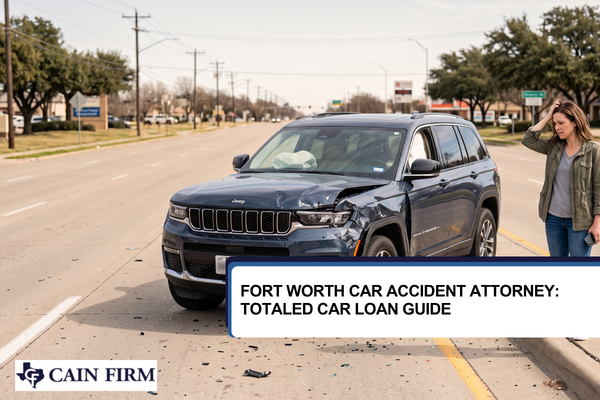
What happens if your car is totaled but you still owe the bank in Texas? The insurer generally pays based on the vehicle’s value, not your remaining loan balance. If the insurance payment is less than the payoff amount, you may remain responsible for the difference unless GAP coverage may help pay some or all of the difference between the vehicle’s actual cash value settlement and the covered loan balance, subject to the product’s terms, limits, exclusions, and eligibility requirements.
You are already dealing with the shock of a crash when the insurance company delivers another problem: your vehicle is a total loss. Then you check your loan balance and realize you owe $28,000 on a car the insurer says is worth only $23,000.
That $5,000 difference does not automatically disappear.
A Fort Worth car accident attorney often hears from injured drivers who assumed the at-fault driver’s insurer would pay off whatever remained on the vehicle loan. Texas insurance guidance says that is generally not how total loss payments work. Insurers usually value the vehicle itself, not the size of your loan. If the car’s value is below your payoff balance, you may still owe money unless GAP or another form of loan protection applies.
This issue can become even more stressful when the crash also caused injuries, missed work, medical bills, or a dispute over fault. The property damage claim and personal injury claim need to be handled carefully so one financial problem does not distract from another.
What Does It Mean When an Insurance Company Totals Your Car in Texas?
A vehicle is considered a total loss when the insurer decides repairing it does not make financial sense compared with its pre-crash value. The Texas Department of Insurance says an insurer will compare the cost of repairs with the value of the vehicle. If repairs cost about as much as, or more than, the vehicle’s value, the company will likely total it. Some insurers may make that decision even when repair costs are somewhat lower.
That is different from the question of how much you financed.
Actual cash value matters more than your loan balance
Most total loss claims revolve around the car’s actual cash value, often called ACV. In practical terms, this means the value of the vehicle immediately before the crash, taking age, mileage, condition, options, and depreciation into account.
The insurer generally does not ask:
- How large was your original loan?
- How much interest remains?
- Did you roll an old car loan into this loan?
- How much did you put down?
- How much would it cost you to buy a new replacement vehicle?
Instead, it tries to establish what your particular vehicle was worth before the wreck.
TDI specifically warns that when a totaled vehicle is financed, the insurer’s payment may not be enough to pay the loan because the vehicle’s market value can be lower than the debt.
Why the 2026 Texas rules matter
As of its July 23, 2026 update, the Texas Department of Insurance continues to advise consumers that they can ask the insurer what source it used to determine vehicle value and can challenge that amount with local market evidence.
That makes the valuation report one of the first documents you should review rather than treating the insurer’s initial number as final.
Once the vehicle is totaled, the financial problem becomes clearer: the car’s value and the loan payoff may be two very different numbers.
Why Your Insurance Payment May Be Less Than Your Car Loan
Owing more than a vehicle is worth is sometimes called negative equity. It is common when a borrower finances most of the purchase price, chooses a long loan term, rolls debt from a previous vehicle into a new loan, or owns a vehicle that depreciates quickly.
The Consumer Financial Protection Bureau explains that standard auto insurance generally pays only up to the vehicle’s value, while GAP products are designed to address some or all of the difference between that amount and the remaining loan balance.
A simple total loss example
Assume:
- Your lender payoff is $31,000.
- The insurer determines the vehicle was worth $26,000.
- Your applicable deductible is $1,000.
- The resulting property damage payment is $25,000.
You could still face a significant unpaid balance after the insurance proceeds are applied.
The exact calculation depends on which insurer is paying, your policy, your deductible, the loan terms, and whether GAP applies. Do not rely on a rough estimate from an adjuster or dealership.
Your loan does not disappear with the vehicle
This is the part many drivers find frustrating. You financed the vehicle, the vehicle is gone, but the loan contract may remain.
TDI states plainly that if the vehicle’s market value is below what you owe, the total loss payment might not satisfy the loan. CFPB likewise advises consumers to compare the insurance payment with the outstanding balance because they may still owe the lender after a total loss.
Mistake to Avoid: Do not stop making required loan payments merely because the vehicle was totaled. Unless the lender tells you otherwise in writing, the loan obligations may continue while the insurance and GAP claims are being processed.
Crash numbers show how often Texas families face major losses
Texas recorded 251,977 people injured in motor vehicle crashes during 2024. The state also recorded 14,905 serious injury crashes involving 18,218 seriously injured people. A reportable crash occurred approximately every 57 seconds.
The vehicle payoff is only one part of the financial damage when a collision also causes physical injuries.
Who Gets the Insurance Check When the Bank Has a Lien?
When you finance a vehicle, the lender typically holds a lien. A lien is a legal interest in the vehicle that helps secure repayment of the loan.
Because the lender has a financial interest in the car, the total loss proceeds are not always simply handed to you.
When the settlement is larger than the loan
Suppose the insurer values your vehicle at $30,000 and your lender payoff is $22,000.
TDI explains that an insurer may coordinate with you and the lender, pay the lender enough to release the lien, and then pay the remaining balance to you. In that example, the lender could receive $22,000 and you could receive the remaining $8,000, subject to the actual claim terms and any deductible or other adjustment.
When the settlement is smaller than the loan
Now reverse the numbers.
If the vehicle is valued at $22,000 but the payoff is $30,000, the insurance payment generally does not grow simply because the debt is larger. Unless another coverage applies, you may still owe the difference.
This is why an auto accident lawyer Fort Worth drivers contact after a serious crash may ask to see not only the insurance valuation but also:
- Your current lender payoff statement
- The retail installment contract
- GAP documents
- Vehicle purchase documents
- Extended warranty information
- Service contracts
- Insurance policy declarations
- Any loan or lease payoff protection endorsement
What happens to the lien after payment?
TxDMV states that after a lien has been paid off, the lienholder generally has 10 days after receiving payment to release the lien. Electronic liens are handled through the vehicle title system, while paper titles follow a different release process.
Quick tip: Ask your lender for a written payoff quote with an expiration date. Your online account balance may not equal the exact payoff amount because of accrued interest, fees, or timing.
If the insurer’s payment does not cover that payoff, the next document to find is your GAP agreement.
How GAP Coverage Can Change What You Still Owe
GAP stands for Guaranteed Asset Protection. Depending on the product and its contract, GAP may cover some or all of the difference between the vehicle’s covered loan balance and the amount the auto insurer pays after a theft or total loss. Coverage is subject to the product’s terms, limits, exclusions, and eligibility requirements.
The Texas Department of Insurance and CFPB both describe GAP this way.
Example with GAP coverage
Suppose:
- Covered loan payoff: $34,000
- Insurance settlement: $28,000
- Potential shortfall: $6,000
A qualifying GAP product may pay some or all of the $6,000 shortfall. The amount paid will depend on the GAP agreement, the insurer’s settlement, the loan account, and any applicable exclusions or limits.
GAP may not cover the entire shortfall
GAP does not necessarily pay every dollar owed on a vehicle loan. Depending on the contract, exclusions or limitations may apply to amounts such as:
- Overdue loan payments;
- Unpaid finance charges;
- Warranty or service-contract costs;
- Balloon payments;
- Insurance deductibles;
- Prior vehicle damage; and
- Other amounts excluded by the agreement.
The specific GAP contract controls. Before assuming that GAP will eliminate the entire balance, review the agreement or ask the lender or GAP provider to explain what is covered.
Mistake to Avoid: Do not assume the dealership’s GAP product and your insurer’s GAP policy work the same way.
TDI specifically notes that some GAP products sold by dealerships or banks may not technically be insurance. If they are not insurance products, TDI may not have authority to resolve disputes involving them.
Where should you look for GAP?
Check:
- Your automobile insurance policy
- Your retail installment sales contract
- Your loan agreement
- Your lease paperwork
- Dealer add-on documents
- Credit union or bank protection products
If you cannot identify the coverage, ask both the lender and insurance carrier in writing.
Mid-content CTA: If the crash also caused injuries, do not let the property damage paperwork consume all your attention. Cain Firm offers free consultations for injured Texans and handles qualifying personal injury cases on a contingency-fee basis, with no upfront attorney fee.
GAP can solve the loan shortfall problem, but it cannot fix an undervalued vehicle. That requires a different strategy.
How to Challenge a Low Total Loss Valuation
An insurance company’s first valuation is not automatically the final word.
TDI’s current guidance says you can ask what source the insurer used to value the vehicle and negotiate if you believe the figure is too low. Consumers can support a higher value with local dealer quotes, online listings for similar vehicles, and documentation of special features or custom equipment.
Review the valuation report line by line
Look for errors involving:
- Wrong trim level
- Incorrect mileage
- Missing factory packages
- Incorrect engine or drivetrain
- Wrong condition rating
- Comparables located too far away
- Vehicles with very different mileage
- Missing aftermarket equipment
- Incorrect prior-damage adjustments
A small error can change the final number enough to matter when you are already upside down on the loan.
Build your own comparable vehicle file
Collect three to five vehicles that closely match yours in:
- Model year
- Make and model
- Trim
- Mileage
- Options
- Condition
- Geographic market
Local evidence can be especially useful because TDI recommends showing what comparable vehicles are actually selling for in your area.
Ask whether appraisal is available
If your own insurance company is handling the total loss and you disagree with its value, your policy may contain an appraisal process. TDI explains that appraisal may involve each side selecting an appraiser, with an umpire used when necessary to resolve disagreement. Check the policy because deadlines and procedures can differ.
Can you keep the totaled vehicle?
Possibly.
TDI says an owner may ask to keep a totaled vehicle, but the insurer can subtract its salvage value from the settlement. TxDMV warns that salvage vehicles face title and inspection requirements before they can legally return to the road. A salvage history may also make future insurance or resale harder.
Before keeping a financed total loss, also talk to the lienholder. TDI specifically recommends checking whether owner-retained salvage affects the lender’s lien.
A valuation dispute is a property issue. If you were physically injured too, a separate set of legal questions becomes important.
What a Fort Worth Car Accident Attorney Can Do After a Total Loss
A Fort Worth car accident attorney is most important when a total loss is part of a larger injury claim. The lawyer can help keep the vehicle dispute from overshadowing medical treatment, liability evidence, lost income, and future damages.
Property damage and personal injury are different losses
A totaled car represents property damage. Your physical injuries are a separate category of loss.
Depending on the facts, an injury claim can involve:
- Emergency medical care
- Surgery
- Rehabilitation
- Lost wages
- Reduced future earning ability
- Pain
- Physical impairment
- Disfigurement
- Other legally recoverable losses
Do not assume that settling the vehicle automatically settles the injury claim. At the same time, never sign a release without reading it carefully. A broadly written release can affect rights beyond the issue you thought you were resolving.
A lawyer can investigate fault separately from the total loss decision
The insurer’s decision to total the car does not prove who caused the crash. Liability still depends on evidence such as:
- Crash reports
- Vehicle damage patterns
- Photos and videos
- Witness testimony
- Traffic camera footage
- Cellphone evidence
- Vehicle electronic data
- Applicable traffic laws
Texas follows a modified proportionate responsibility system. Under Civil Practice and Remedies Code Section 33.001, a claimant who is more than 50 percent responsible generally cannot recover damages. When the claimant is 50 percent or less responsible, damages may be reduced based on that percentage.
Choosing legal help carefully
Terms such as professional lawyer for car accidents Texas, affordable accident lawyers Fort Worth, or accident lawyer with results Texas should not substitute for checking the lawyer’s license, relevant experience, fee agreement, communication practices, and ability to handle the particular case. No attorney should promise a result based on advertising language alone.
Cain Firm focuses on Texas injury and wrongful death cases, with offices in Fort Worth and Granbury and service across Texas. Its founder, Brett Cain, previously served as a Texas prosecutor. The firm offers free consultations and contingency-fee representation for qualifying injury matters.
The next issue is avoiding common mistakes while the insurer, lender, and medical claim are all moving at the same time.
Common Mistakes After a Financed Vehicle Is Totaled
A total loss creates several parallel problems. You may be communicating with an adjuster, lender, GAP administrator, rental company, repair facility, medical providers, and an attorney during the same week.
These mistakes can make that situation worse.
1. Assuming the insurer must pay your full loan balance
It generally does not. The vehicle’s value and loan debt are different figures. GAP exists largely because those numbers do not always match.
2. Accepting the valuation without checking the vehicle details
Make sure the insurer used the right trim, mileage, options, and local comparables.
3. Forgetting to file the GAP claim
The auto insurer and GAP provider may be separate companies. Do not assume one automatically notifies the other.
4. Stopping loan payments without lender approval
The loan may continue even though the car cannot be driven. Late payments can create additional financial problems and may affect some GAP calculations.
5. Signing a broad release too quickly
Read every settlement document. Make sure you understand whether it concerns property damage only, bodily injury, or all claims.
6. Keeping the salvage vehicle without understanding the consequences
Keeping a totaled vehicle can reduce the insurance payment. It may also create title, repair, inspection, financing, resale, and insurance complications.
7. Focusing on the car while ignoring physical symptoms
A totaled vehicle can dominate your attention because you still need transportation. But headaches, back pain, numbness, neck stiffness, dizziness, and other symptoms should not be ignored.
8. Waiting too long to protect an injury claim
Texas Civil Practice and Remedies Code Section 16.003 generally provides a two-year limitations period for personal injury claims, subject to exceptions and special rules. Evidence can disappear much sooner.
Mistake to Avoid: A two-year lawsuit deadline does not mean you should wait two years to investigate the crash.
The safest approach is to organize each problem separately and work through the total loss process in a logical order.
What Happens Step by Step After a Texas Total Loss
The timeline can vary, but most financed total loss claims follow a similar sequence.
Step 1: Report the collision and protect the evidence
Typical timing: Immediately after the crash.
Report the accident, photograph the vehicles, save witness information, and obtain medical care when needed. Keep copies of communications from both insurance companies.
Step 2: The insurer evaluates the damage
Typical timing: Days to several weeks.
The company inspects the car or reviews an estimate and determines whether repairs make financial sense compared with vehicle value.
TDI says that when repair costs are close to or greater than the car’s current value, the vehicle will probably be totaled.
Step 3: Request the valuation report
Do not focus only on the settlement number.
Ask for the report showing:
- Vehicle specifications
- Mileage
- Condition
- Adjustments
- Comparable vehicles
- Market data
Check it for errors.
Step 4: Obtain the Lender's Payoff Amount
Ask the lender for a written payoff statement showing the amount required to satisfy the loan as of a specific date. Compare that figure with the insurer’s proposed total-loss settlement.
The result generally falls into one of three categories:
- Settlement exceeds the payoff: The lender’s interest is addressed, and any remaining amount may be paid to you, subject to the insurer’s and lender’s final calculations.
- Settlement equals the payoff: The loan may be satisfied once the lender processes the payment and completes its final accounting.
- Settlement is less than the payoff: A deficiency may remain unless GAP or another applicable product covers some or all of the difference.
Because payoff amounts can change with interest, fees, and payment timing, ask the lender how long the quote remains valid and what happens while the total-loss claim is pending.
Step 5: Submit the GAP Claim
If you purchased GAP, contact the GAP provider or lender as soon as possible. Ask for the GAP contract, claim instructions, filing deadline, and list of required documents.
Depending on the product, the provider may request:
- The insurer’s total-loss valuation;
- The insurance settlement statement;
- A current loan payoff statement;
- Payment history;
- The retail installment contract or loan agreement;
- Evidence of the insurance payment;
- A police report or other loss documentation, when applicable; and
- Any additional documents identified in the GAP agreement.
Continue monitoring the loan account until the lender confirms in writing that the balance has been paid, adjusted, or otherwise resolved.
Step 6: Review and, If Appropriate, Dispute the Vehicle's Value
Review the insurer’s valuation for accuracy. Check the vehicle’s:
- Year, make, model, and trim;
- Mileage;
- Condition;
- Optional equipment and upgrades;
- Prior damage;
- Recent improvements or maintenance; and
- Applicable deductible, taxes, and fees.
If the valuation omits equipment or relies on inaccurate information, provide documentation such as stronger comparable vehicles, purchase or maintenance records, photographs, window stickers, and records of factory or aftermarket options. Ask the insurer to explain its valuation methodology and to issue a revised valuation if the evidence supports one.
Step 7: Handle the title and lien
The insurer and lender may coordinate title transfer and lien payoff. If you keep the car, ask both the insurer and lender how owner-retained salvage affects the transaction.
Step 8: Keep the injury claim moving
Do not wait for the car issue to be finished before documenting medical treatment and lost income.
Step 9: Review settlement documents before signing
Make sure you know exactly which claims the release resolves.
Step 10: Consult counsel when the crash involves injury or disputed liability
An auto accident lawyer Fort Worth residents contact can review how the property claim relates to the larger injury case and help prevent an early insurance decision from defining the entire claim.
Common Questions About Totaled Cars and Auto Loans in Texas
What happens if my financed car is totaled in Texas?
The insurer generally determines the vehicle’s value and pays according to the applicable coverage rather than automatically paying whatever remains on your loan. If a lender has a lien, the lender may receive insurance proceeds first. If the settlement is below the loan payoff, you may remain responsible for the difference unless GAP or another protection product applies.
Does the at-fault driver's insurance have to pay off my entire loan?
Not simply because the other driver caused the crash. Property damage compensation generally focuses on the value of the damaged vehicle. Your loan balance can be higher because financing and depreciation are separate from the car’s market value. If the other insurer disputes liability, TDI notes that drivers with collision coverage may be able to use their own policy while their insurer later seeks reimbursement.
Can I negotiate the value of a totaled car?
Yes. Texas Department of Insurance guidance encourages drivers who believe the value is too low to gather local dealer quotes, online listings for comparable vehicles, and documentation of special features or custom equipment. Ask the insurer to explain its valuation before deciding whether to challenge it.
What if I do not have GAP insurance?
If the insurance settlement is lower than the loan payoff and you do not have applicable GAP or loan protection, you can remain responsible for the remaining debt. CFPB and TDI both warn consumers about this possibility. Contact the lender promptly to confirm the exact balance and discuss available payment options rather than assuming the debt has been canceled.
Can I keep my totaled car?
You may be able to retain the vehicle, but the insurer can reduce the settlement by the salvage value. Texas title requirements may also apply before the vehicle can legally return to the road. If the car is financed, speak with the lender before choosing owner-retained salvage because the lender still has an interest in the vehicle.
Frequently Asked Questions
Q: Does hiring a Fort Worth car accident attorney increase the value of my totaled car?
A: An attorney cannot change the vehicle’s actual pre-crash condition or guarantee that an insurer will increase its valuation. When a serious injury claim accompanies the total loss, however, counsel can review the property damage process, identify valuation issues, protect evidence, and keep the vehicle dispute separate from the bodily injury claim. The value of any legal claim depends on its particular evidence and applicable law.
Q: Should I sign the property damage settlement before my injury case is finished?
A: Sometimes a property damage matter can be resolved before the bodily injury claim, but you should read the release carefully. Do not assume a document applies only to the car because that is what you discussed with the adjuster. If the language is broad or unclear, have it reviewed before signing. Once legal rights are released, reversing that decision can be difficult.
Q: What if the insurer used the wrong mileage or trim level?
A: Notify the adjuster in writing and provide documents showing the correct information. Useful proof can include purchase records, maintenance invoices, photographs, VIN information, equipment lists, and local listings for comparable vehicles. TDI specifically recommends providing local pricing and documentation of special equipment when disputing a valuation.
Q: Does GAP Pay the Insurance Deductible?
A: It depends on the contract. Some GAP products may exclude or limit coverage for an insurance deductible, while others may address it differently. Dealer GAP products, lender-offered products, and insurance-company GAP coverage may contain different terms.
Review the GAP agreement before assuming that the entire difference between the insurance settlement and the loan balance, including the deductible, will be covered.
Q: Can I Search for Texas Legal Aid for a Vehicle Accident?
A: Yes. Texas legal-aid organizations and private personal-injury firms generally operate under different eligibility and fee structures.
Nonprofit legal-aid organizations may provide free or reduced-cost civil legal services to people who meet their financial and case-related requirements. Many private personal-injury firms handle qualifying cases on a contingency-fee basis, meaning the attorney’s fee is generally contingent on recovering compensation under a written agreement.
Cain Firm states that it offers free consultations and contingency-fee representation for qualifying injury cases. Prospective clients should confirm the firm’s current service area, eligibility requirements, and fee agreement during the consultation.
Q: Does Cain Firm handle cases outside Fort Worth?
A: Yes. Cain Firm is rooted in Fort Worth and Granbury and states that it serves injured people throughout the Dallas-Fort Worth Metroplex and across Texas. That includes communities such as Arlington, Grand Prairie, Amarillo, Dallas, and other Texas locations. The firm provides free consultations for people seeking help after car crashes and other personal injury matters.
Your Car May Be Gone, But Your Financial Questions Are Not
A total loss can leave you without transportation, still making loan payments, and unsure why the insurance check does not match what you owe. When the crash also caused injuries, the financial pressure becomes even harder to manage.
A Fort Worth car accident attorney can help you separate the vehicle claim from the personal injury claim, preserve evidence, evaluate liability, and understand the insurance issues surrounding a serious crash. Cain Firm represents injured Texans from its Fort Worth and Granbury offices and serves clients throughout Texas. Free consultations are available, and qualifying personal injury cases are handled on a contingency-fee basis, subject to the written agreement.
If you were hurt in Fort Worth, Amarillo, Arlington, Bellaire, Benbrook, Dallas, Granbury, Grand Prairie, Irving, Tyler, Waco, or elsewhere in Texas, call Cain Firm today to schedule a free consultation. Texas generally gives injured people two years to file many personal injury lawsuits, but evidence and insurance issues can become harder to address much sooner.
*No law firm can guarantee a result, and past outcomes do not predict the outcome of a future case.*


